
Everything We Saw at Art Basel with Airnbnb Experiences (And a Few We Walked Right Past)
There were 59 installations in Unlimited this year. I briefly entertained the idea of covering all of them in an hour for my Art Basel x Airbnb Experiences tour, and that idea lasted exactly as long as it took me to walk in and look at the first work and realise this edition was going to be epic. So instead, I did what I always do: I picked the handful that I couldn’t get out of my head, researched the heck out of them, and I let everything else have its moment as we walked past.
This is the first Unlimited curated by Ruba Katrib, of MoMA and PS1 fame, and you can feel her eye for artists working at the intersection of scale, politics, and material experimentation all over this edition. Unlimited has always been about monumental gestures - work too big for a booth, work that belongs in a museum more than a marketplace. What struck me this year, though, is how much of that monumentality is being used to talk about vulnerability instead of power. And there's a quieter thread running through it too: soft materials carrying hard histories. Embroidery, weaving, handwork - basically the “craft techniques” that were dismissed for decades as "women's work" - doing some of the most serious political and emotional work in the entire fair.
Here's where I stopped with our group, and why. Thanks again to Airbnb Experiences for partnering with me on this! Art needs to be seen in real life, and it was super cool that Airbnb is facilitating that for so many.
The Uniforms That Are Too Big to Be Human
Chris Burden's L.A.P.D. Uniforms will make you step back before you've even registered what you're looking at. That's the point. These are police uniforms scaled for officers over seven feet tall, made in 1993 in the aftermath of the Rodney King beating and the Los Angeles riots. Burden didn't make a protest banner. He made the institution gigantic, mythic and a little monstrous. And given he spent the 1970s testing the limits of his own body - most famously having a friend shoot him in the arm for a piece called Shoot - the fact that he turns his attention from the body to the systems that act on it is important. The body disappears here, yet the uniform remains. And thirty years later, it still asks the same unresolved question: at what point does authority become intimidation?
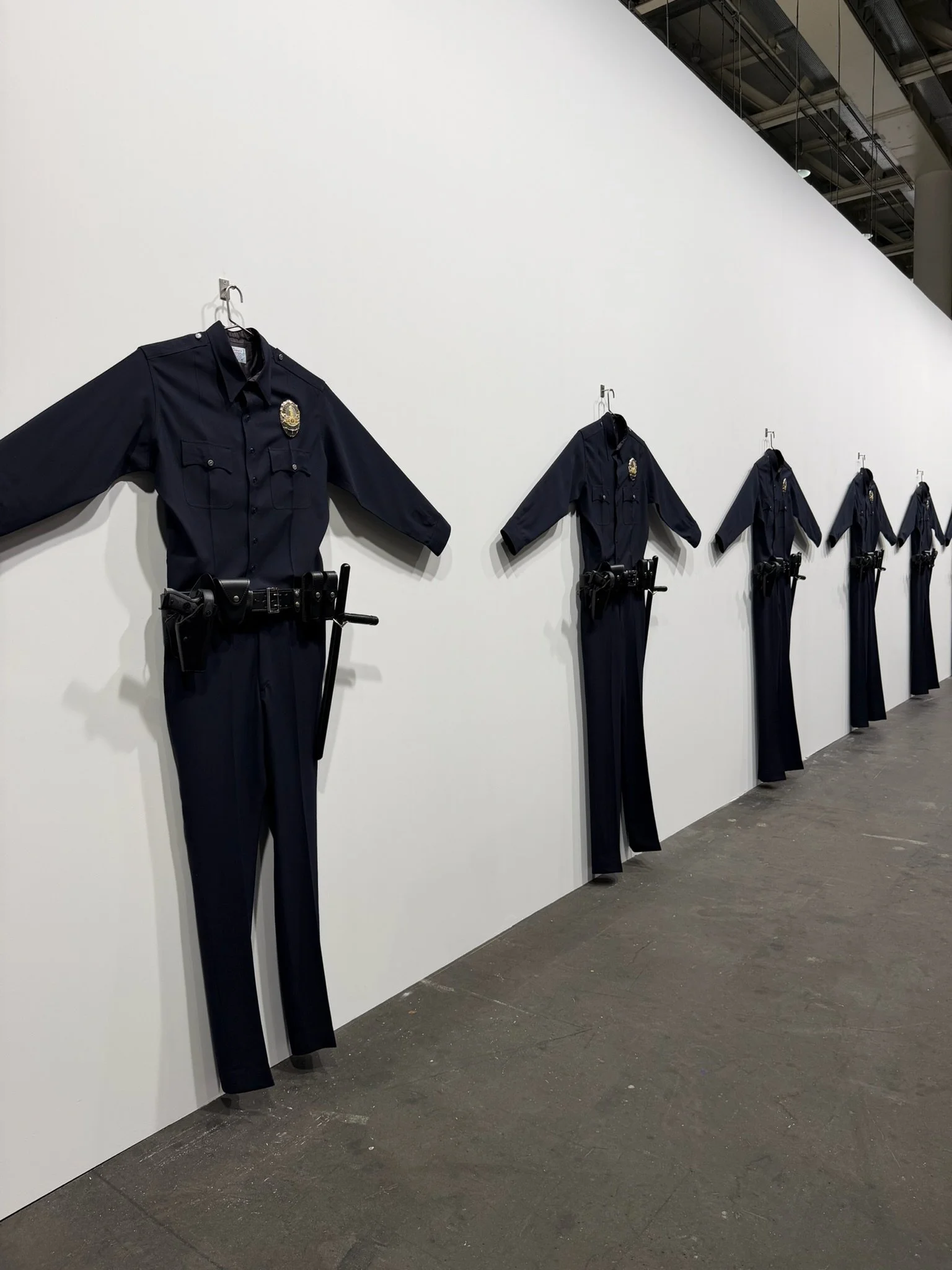
Chris Burden's L.A.P.D. Uniforms
A Field of Grass That Could Stop a Tank
If nobody told you this was an Ai Weiwei work, you might walk past it. If there was just one blade of grass, it’d read as insignificant. But over a thousand blades of grass, all cast in iron, that’s something. And, in Ai’s words, he wanted this field to have power strong enough, “to stop a tank.” That's the whole piece, really: the relationship between the individual and the collective, rendered in the most overlooked material on earth. Grass. The best part, there were two real life bird’s nests in the work. Rumour has it, bird's built them when the work was last shipped. I love that he left them. Given his own history - his father exiled during the Cultural Revolution, his own years in labour camps, his independent investigation into the children killed by poorly built schools in the 2008 Sichuan earthquake - freedom, and a yearning for it runs deep in everything Ai does.
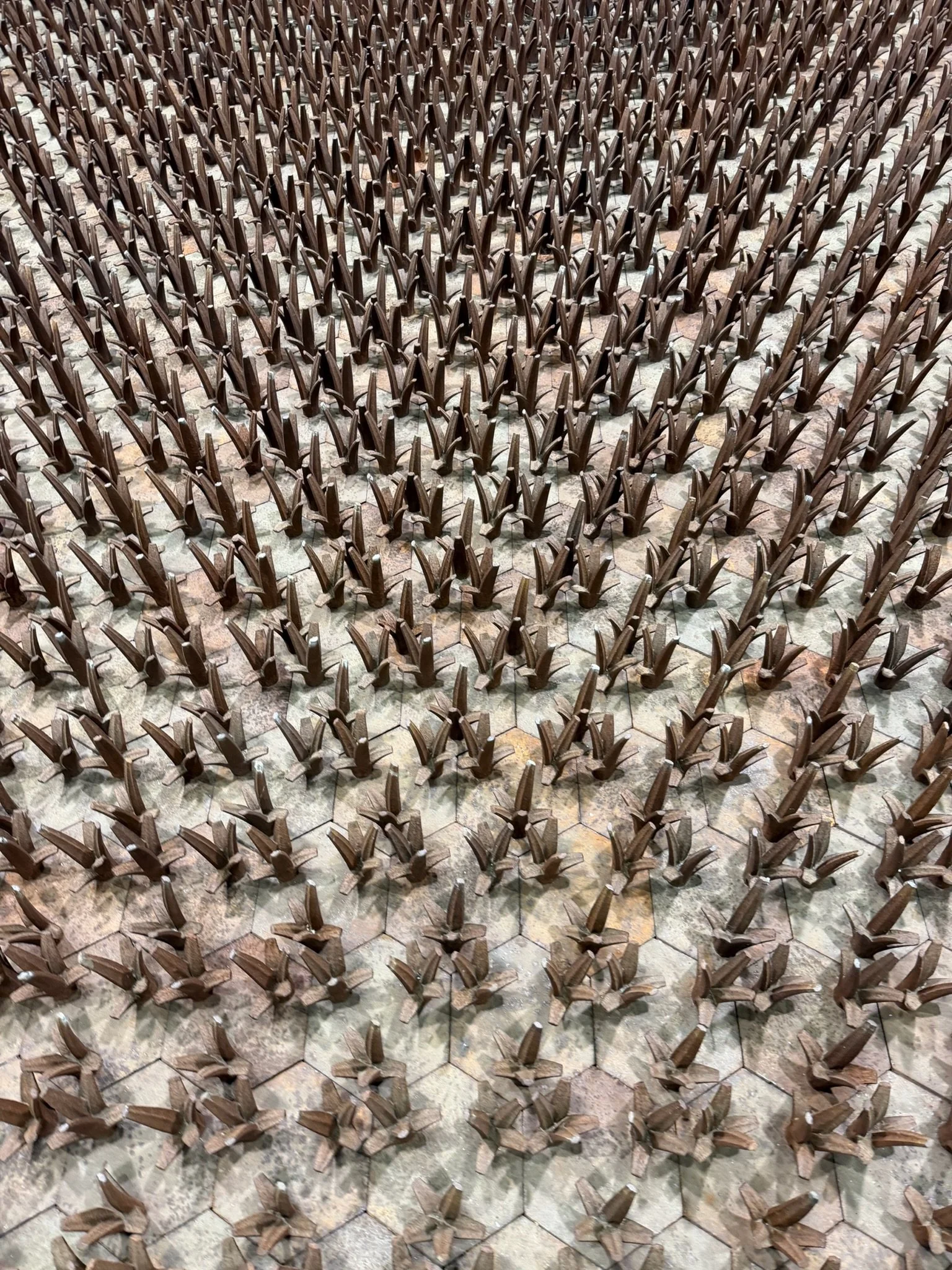
Ai Weiwei, Iron Grass
The Work Everyone's Arguing About
Vanessa Beecroft's new film installation, loosely inspired by the myth of Persephone, generated more conversation at Art Basel, Basel 2026 week than almost anything else in the building - partly because Ye was spotted wandering the fair, partly because Beecroft's work has always split a room. Her women stand still, silent, arranged, and depending on who you ask, that's either a powerful critique of how women get represented or a repetition of the very thing it claims to critique. I land on the latter. But thirty years on, she's still the conversation everyone's having, even when they disagree about what the conversation is.
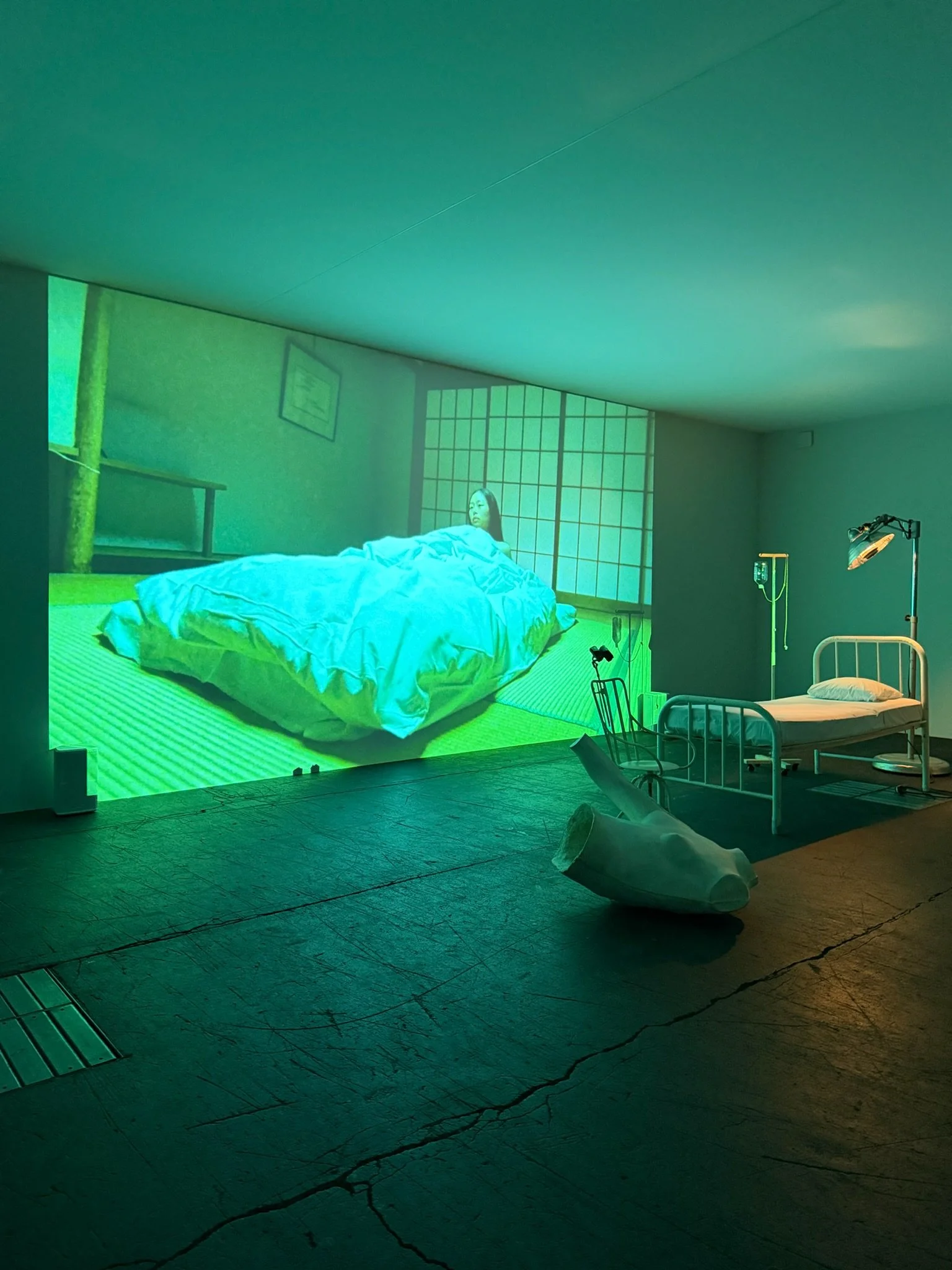
Vanessa Beecroft, Untitled
A Needle and Thread Among All This Steel
In a building full of steel, technology, and enormous budgets, Junko Oki is sitting with a needle and thread, and it's one of the most moving things in the entire section. Anthology is built from hand-stitched embroidery and clay forms made from thousands of donated sewing needles, referencing hari-kuyo - a Japanese memorial tradition for worn-out needles, traditionally laid to rest in tofu and thanked for their service. Oki started sewing with materials left behind by her mother, but the deeper root is a school uniform her grandmother patched together from fabric scraps during the Second World War. Every stitch here represents time, not production. In a fair built on spectacle, that's genuinely rare.
A Wall Made of Thread
Zahrah Alghamdi's Streams Move Oceans looks like a dense wall from across the room. Get closer and you realise it's thousands of fabric fragments, dipped in plaster, knotted together by hand across nearly 30 metres. One thread doesn't do much but thousands of them become a barrier, or a landscape, or a history. Alghamdi represented Saudi Arabia at the 2019 Venice Biennale, and her work consistently returns to materials that carry memory - mud, leather, earth, cloth. The piece borrows the language of a wall without behaving like one: monumental, but fragile. Permanent-looking, but made of the softest possible materials. Which is sort of the question she's asking about borders generally.
Furniture With Feelings
Woody De Othello has built a thirty-metre wall punctuated with openings that work like little shrines, each one housing a hand-built ceramic object made specifically for this piece. Telephones droop. Fans look exhausted. Clocks look anxious. Othello draws on the West and Central African concept of nkisi - the idea that objects can hold spiritual energy - and the result is a fair full of artists trying to go bigger, and one artist asking you to peek through a hole in a wall instead. You don't consume this piece all at once. You discover it.
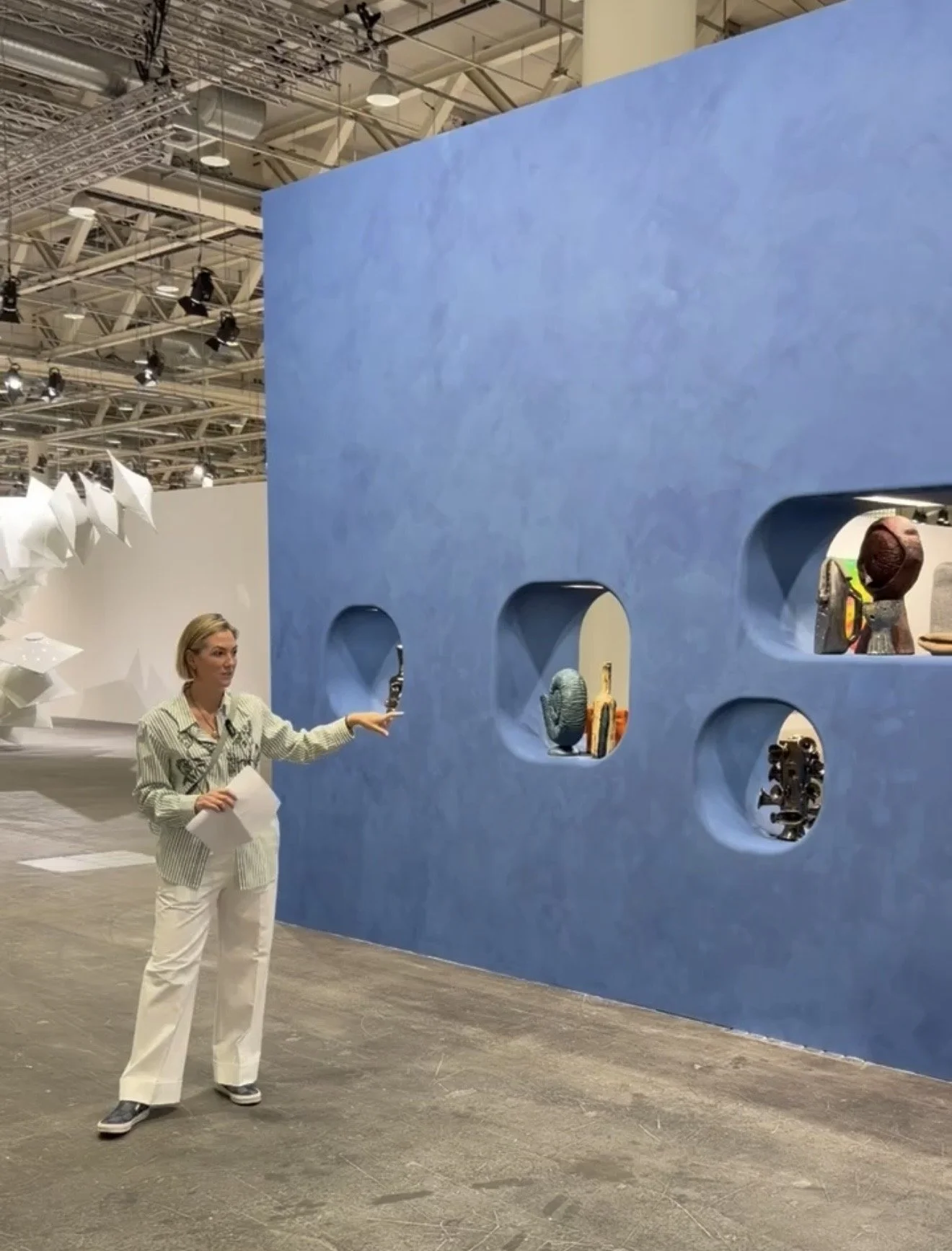
Woody De Othello
A Thousand Bottles, A Thousand Histories
Theaster Gates' A Libation in Uncertain Times looks, at first, like an extremely beautiful storage problem: over a thousand traditional Japanese sake bottles on reclaimed wooden shelving, arranged by glaze from lightest to darkest. Gates trained in ceramics in Japan in the 1990s and has spent decades finding unexpected links between Black American and Japanese histories of craft and preservation. A libation is an offering — a ritual pouring in remembrance of those who came before. That's exactly how this reads. Not a display. An act of gratitude.
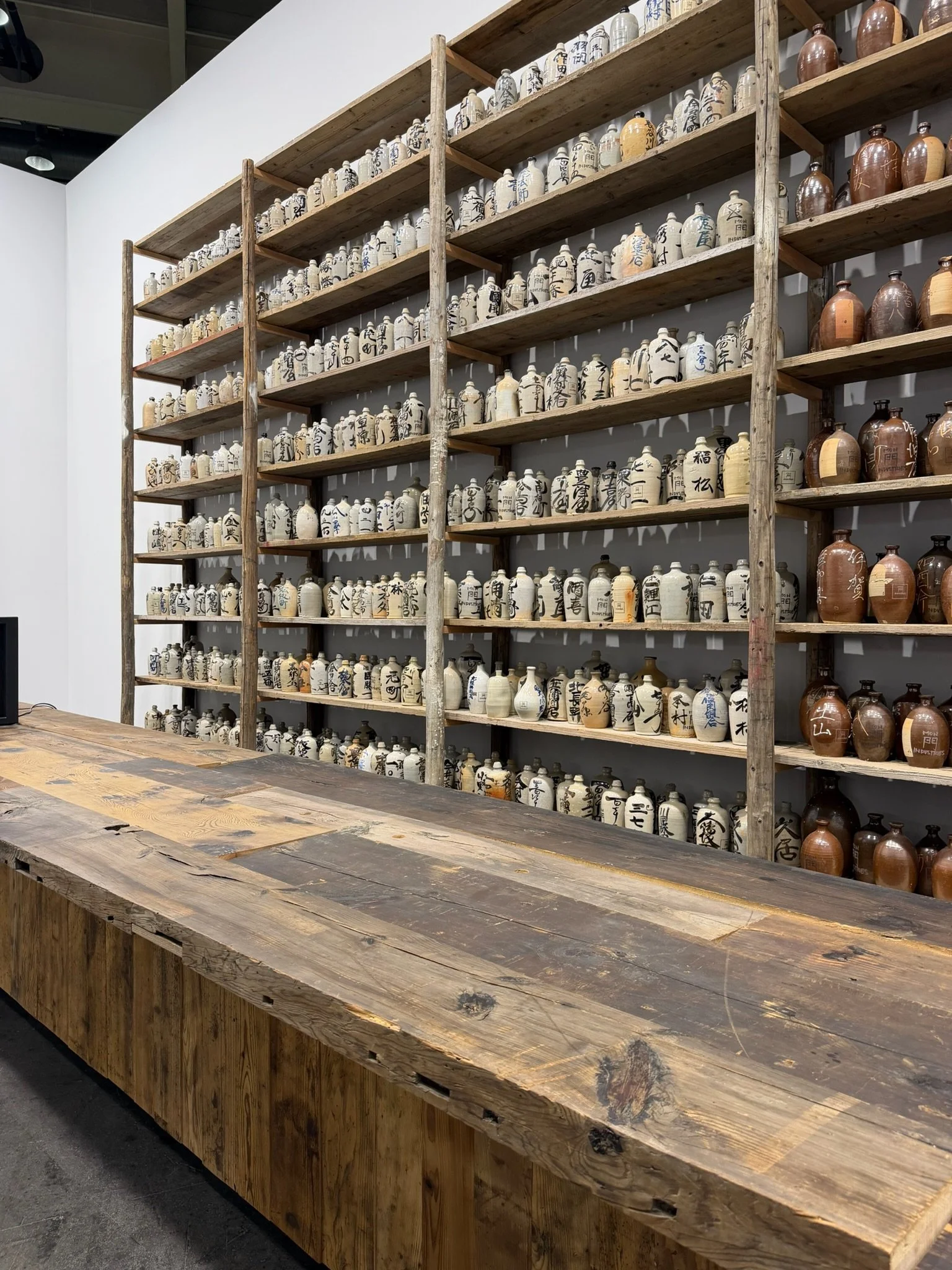
Theaster Gates' A Libation in Uncertain Times
Lace That's Actually Steel
From across the room, Maria Loizidou's Where Am I Now? looks like lace, or a curtain your grandmother might have crocheted. It's stainless steel wire and aluminium. Birds are woven throughout the structure, and they're the key to the whole piece. Loizidou, who is from a still-divided Cyprus, has spent her career on questions of border, migration, and belonging. Birds cross borders without passports. They migrate without permission. They are free. The piece holds two contradictions at once: it looks weightless and is, in fact, extremely heavy; it looks fragile and is, in fact, structurally permanent.
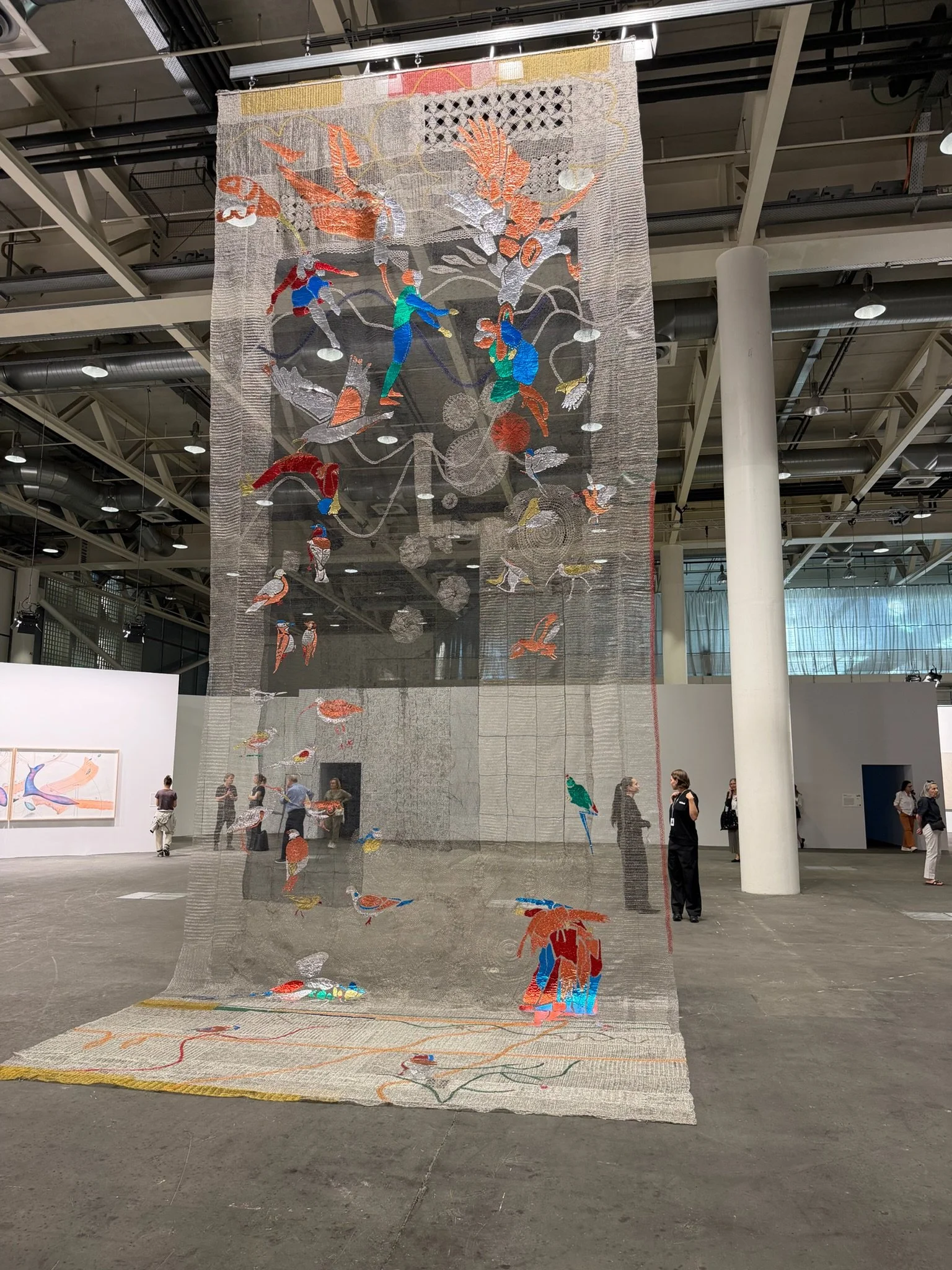
Maria Loizidou, Where Am I Now?
An Entire Forest Made of Cardboard
Eva Jospin's Panorama was originally built for the Cour Carrée at the Louvre in 2016, and it takes its name from the eighteenth-century tradition of paying to enter a circular structure that transported you somewhere else entirely. These were immersive experiences before immersive experiences were a category. You walk through a narrow opening into an invented forest: paths that appear and disappear, roots that become caves, woodland that slowly turns into grotto. And it's all cardboard. Once you know that, I defy you not to be impressed. It's an obsessive, almost architectural feat of labour, built entirely from one of the humblest materials available.
Down on Your Knees for a Mouse
Somebody at Art Basel placed Ryan Gander's tiny animatronic mouse right next to Jospin's fictional forest, and it's a perfect bit of sequencing. You walk out of a fairy tale and meet one of its characters. The mouse lives in a hole in the wall, and to hear it properly, you have to crouch down. This is part of Gander's ongoing series of "prophetic mice," each delivering a monologue voiced by one of his daughters. At a fair where everything is competing to be bigger and louder, Gander makes an entire crowd kneel in front of a rodent. It's one of the smartest reversals in the building.
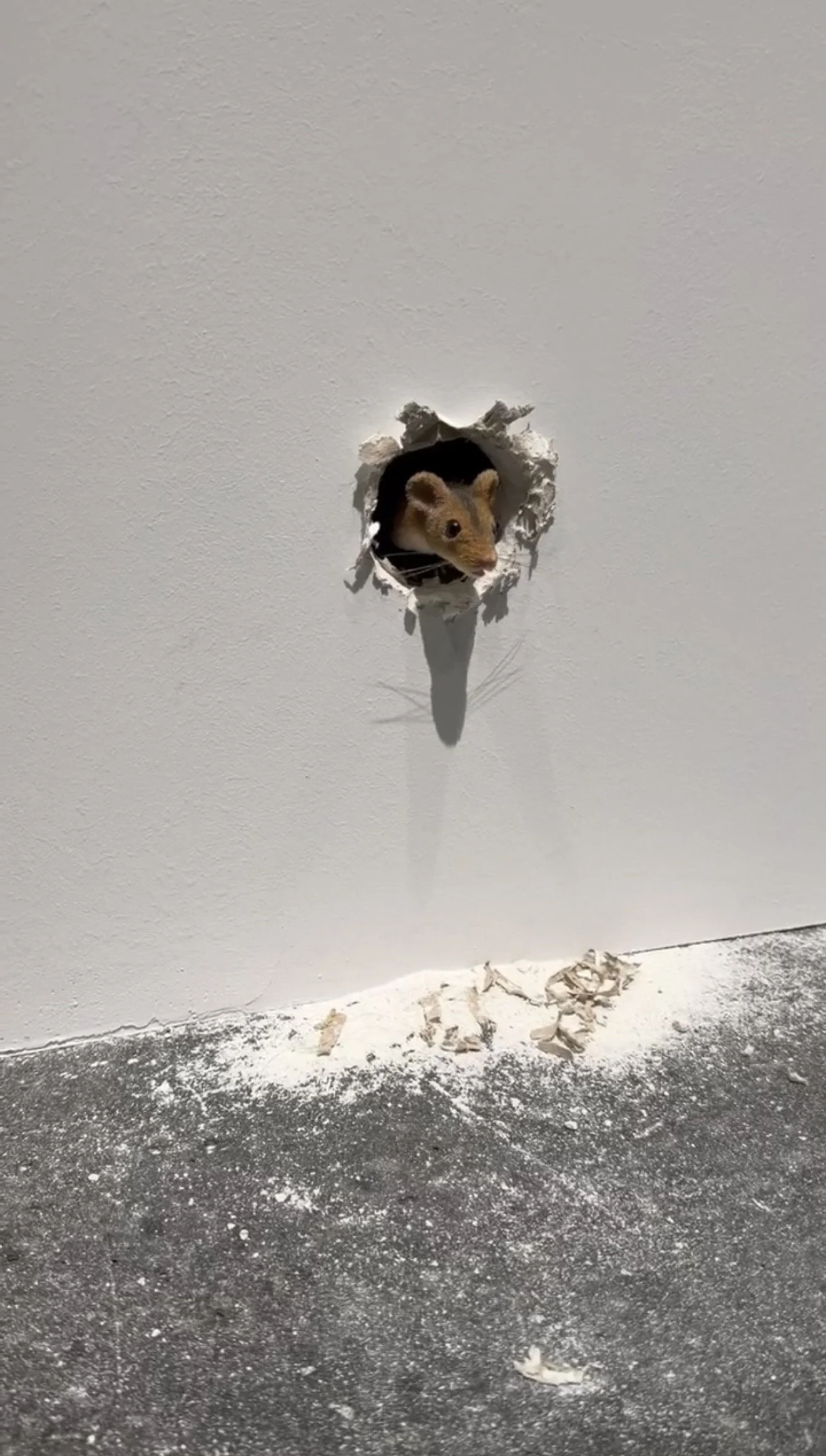
Ryan Gander, I’ve felt Everything I’m Going to Feel
Bombs Turned Into Bells
This might be my favourite work in Unlimited this year and my favourite discovery of the fair in general. Tuan Andrew Nguyen's Repercussions is made from decommissioned bomb casings recovered from Quảng Trị, one of the most heavily bombed regions in human history — unexploded ordnance is still a daily reality there. He's turned them into bells. When struck, they produce a frequency of 432 hertz, often associated with healing. Whether or not you believe in that is beside the point. A bomb is built to create fear. A bell is built to gather people. That transformation, in one object, is beautoful: the same metal that once fell from the sky now hangs here as an invitation to listen, to congregate, to pause. And ultimately, to heal.
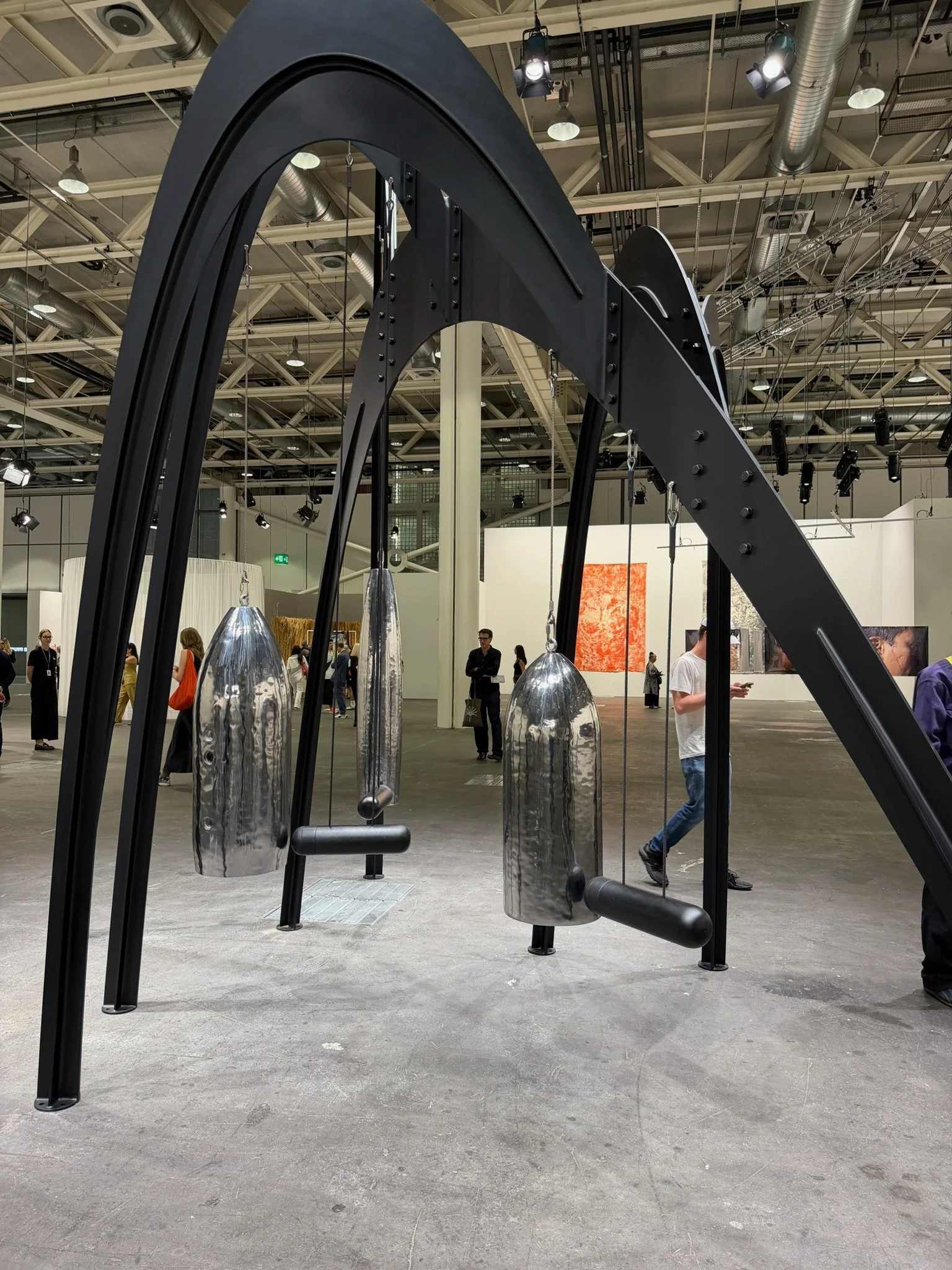
Tuan Andrew Nguyen, Repercussions
Hospital Sheets Become Mountains
I wanted to end on Benoît Piéron's Cairns because it captures something about where contemporary art is right now, where lived experience, unfiltered, shows up directly in the work. At first glance these are playful pastel mountains with cartoon eyes peeking out. They're also made from hospital bedsheets, because Piéron has spent much of his life in them. A cairn is a pile of stones hikers build to help others find their way through difficult terrain. His question is: what if your mountain is a hospital bed? Folds become hills. Creases become valleys. He refuses the usual language of illness as tragedy, and turns it into wonder instead. Which feels like the right note to end on.
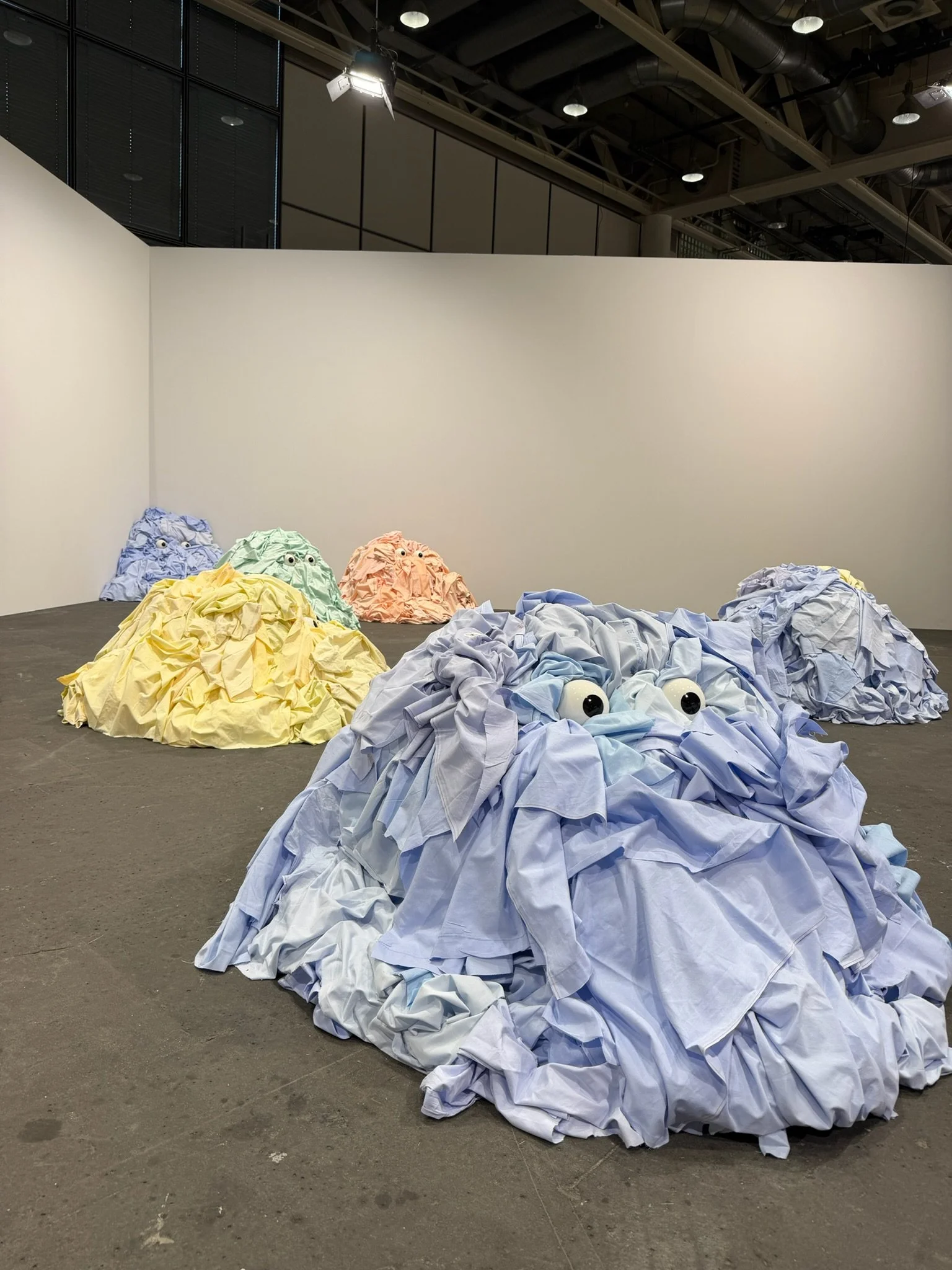
Benoît Piéron Cairns
A few I'll mention without dwelling on: Matthew Barney's mythological universe (worth it if you've got twenty minutes or a postgraduate degree. Otherwise, just look at the drawings), Niki de Saint Phalle's joyful post-AIDS-crisis memorial, Isa Genzken's airplane-window installation (you've already been inside it if you flew in this week), and Yuichi Hirako's crowd of 300 tree-headed figures, quietly reversing who's watching whom.
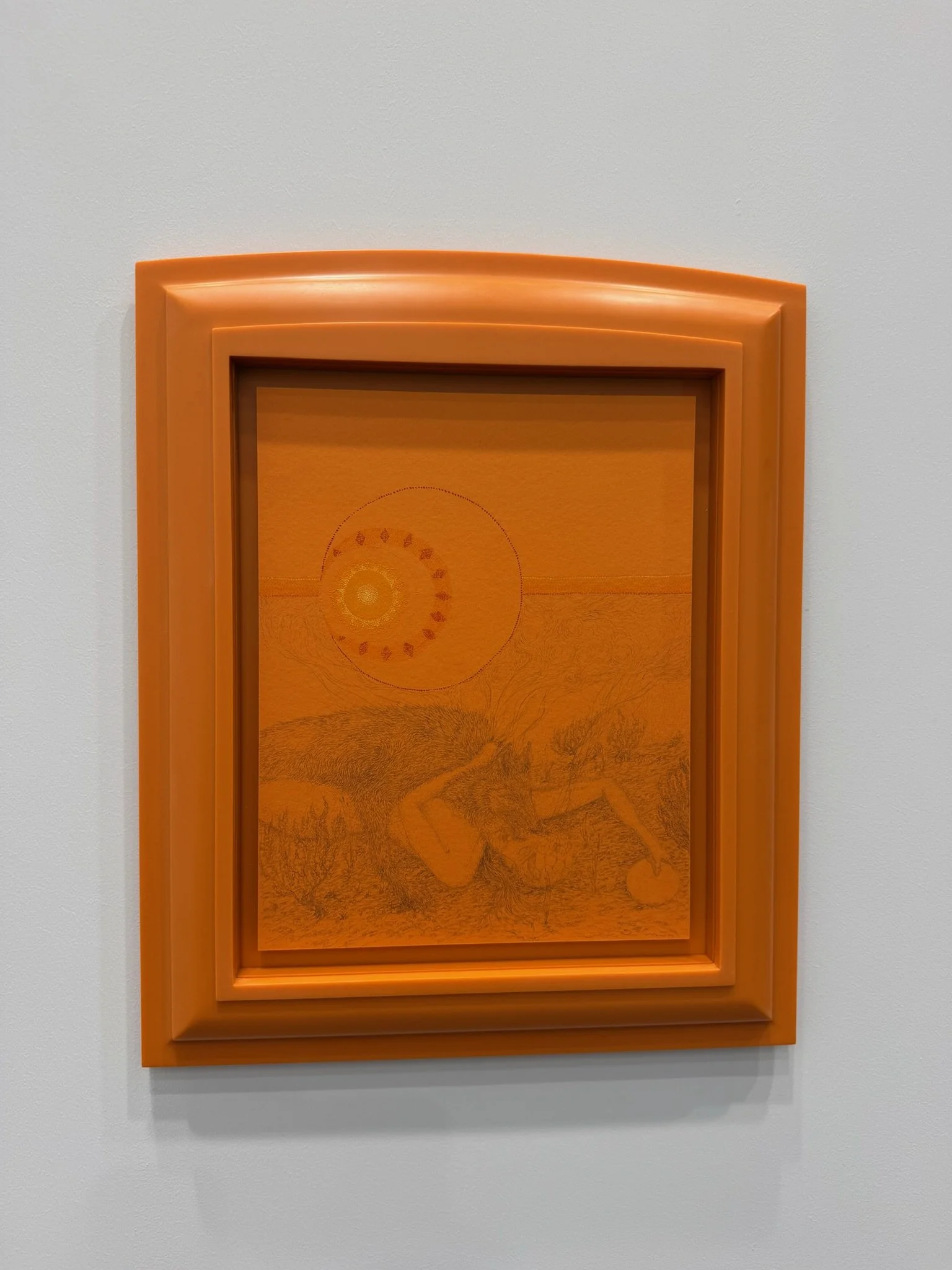
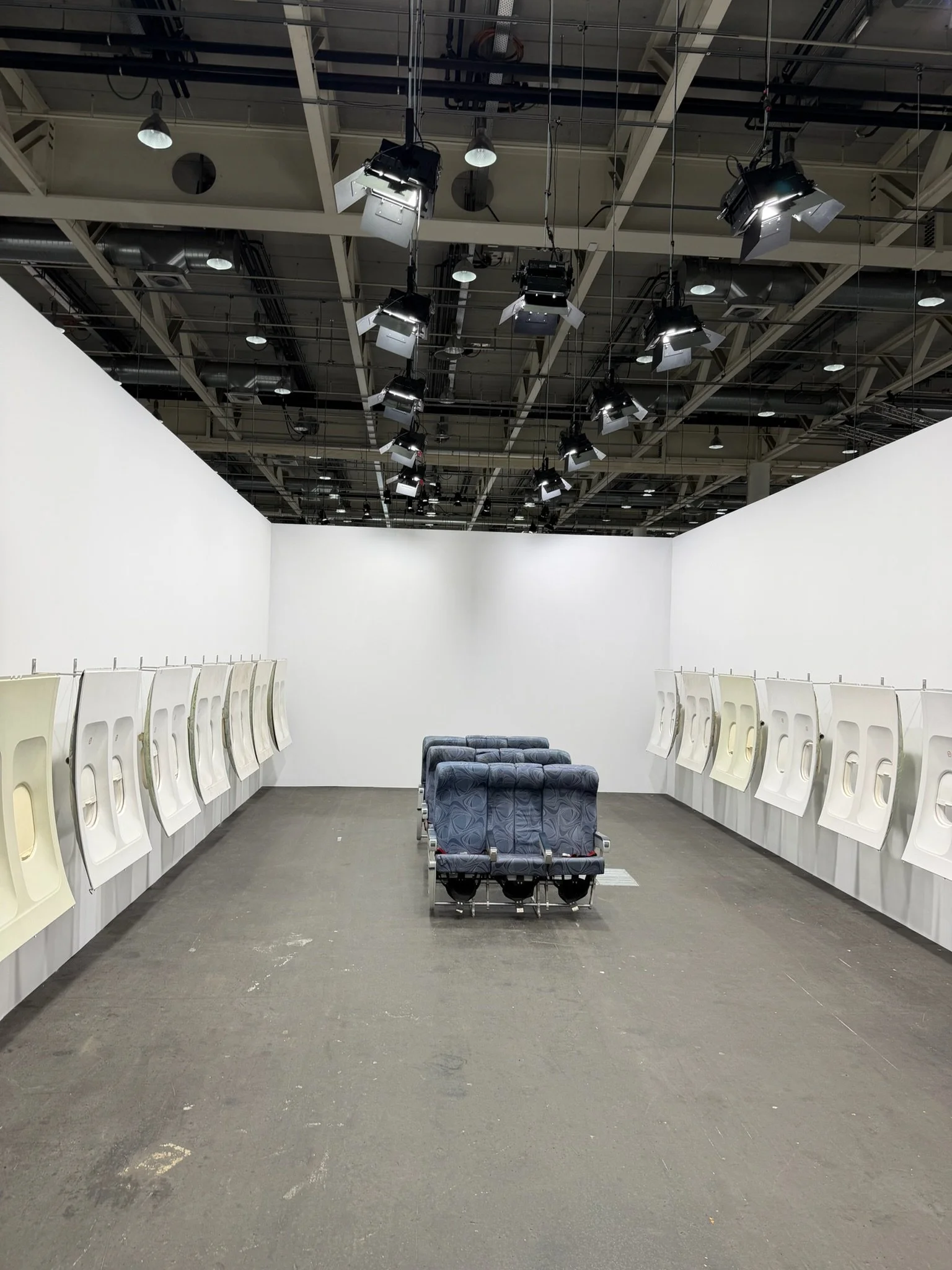
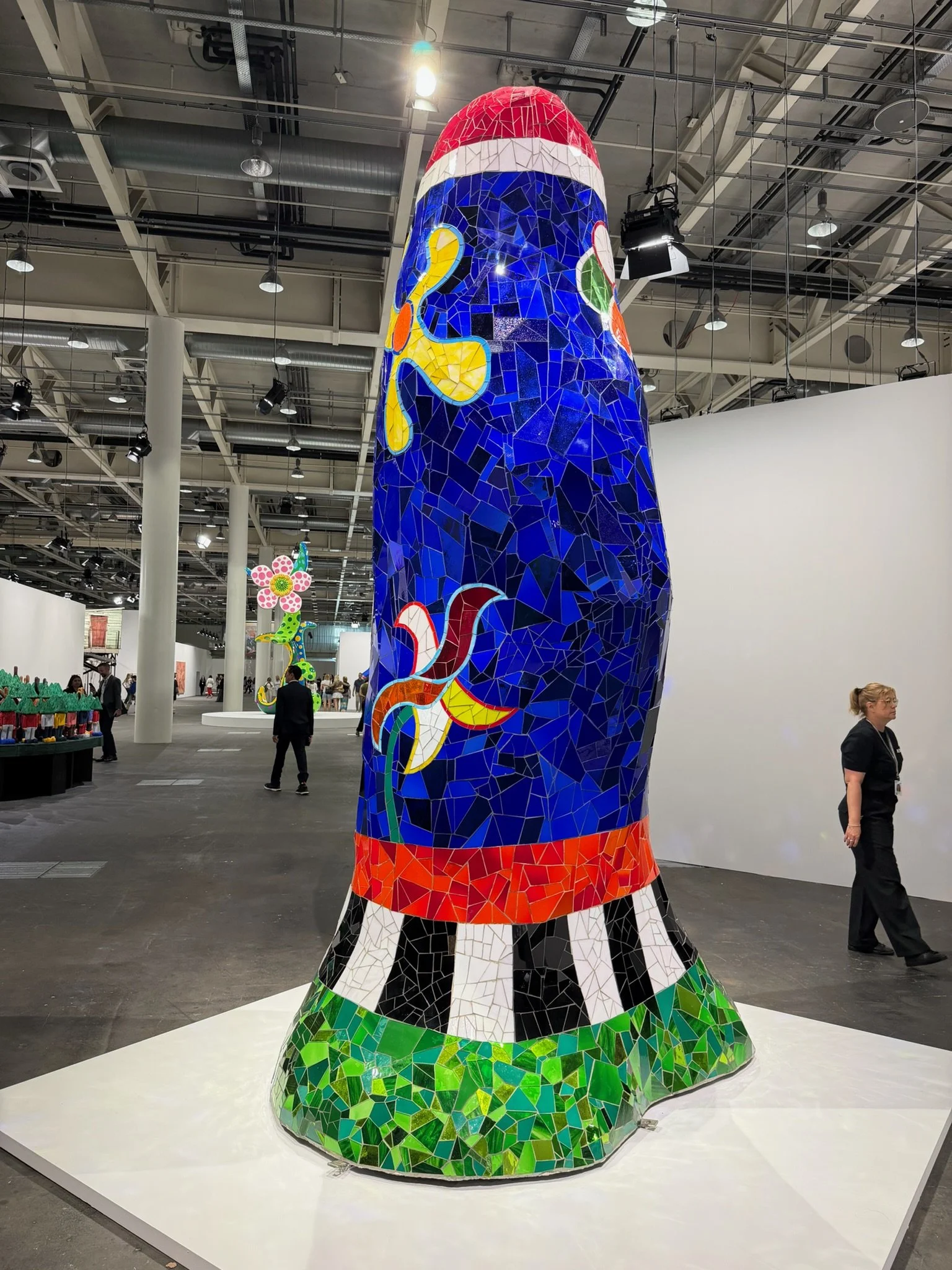
What kept surfacing for me across all twelve stops is how many artists this year are taking the heaviest material available — war, displacement, illness, institutional violence — and refusing to let it end in tragedy. They're asking how you keep living with it instead. How you transform it. How you keep going.