
Bearing Witness: How Nona Faustine Reclaimed New York's Forgotten Slave History | Seen at Large with Chadd Scott

Nona Faustine & Channon Anita, 'They Tagged the Land With Trophies and Institutions From Their Rapes and Conquests, Tweed Courthouse, NYC,' 2013, from the series 'White Shoes (diptych). © 2025 The Estate of Nona Faustine, courtesy The Estate of Nona Faustine and Higher Pictures
What are the great series in art history?
Monet’s Water Lilies. Jacob Lawrence’s “The Migration Series.”
What about photography?
Gordon Parks’ “Segregation Series.”Dawoud Bey’s “Elegy” trilogy.
Nona Faustine’s White Shoes belongs on those lists.
The series features in Faustine’s (1977–2025) first retrospective on view now through May 10, 2026, at CPW Kingston in Kingston, NY where admission is free.
Faustine electrified the art world with unflinching and often shocking photographs boldly interrogating America’s racist past, most notably in naked self-portraits taken at former sites associated with the legacy of slavery around New York. Her hometown. Born, raised, and lived in Brooklyn.
This was White Shoes.
“What we were told about slavery in New York was that we freed our slaves very early, there was very little slavery here, as if it was like the utopia freed North, and it couldn't be any further from the truth,” Faustine explained in a video produced by the Brooklyn Museum for an exhibition of White Shoes there in 2024. “We were one of the largest slave holding Northern states. Brooklyn had the largest amount of slaves. I wanted to do a series that talked about the history of New York with slavery, specifically, and women myself. It was kind of autobiographical.”
Faustine’s great-great grandmother was enslaved. Both sides of her family trace roots back to North Carolina and back further to Africa.
The project was partially a memorialization of people used, abused, and forgotten.
“The anonymous men and women and children who were sacrificed, really, in the building of New York City and of this nation, and who made America, literally by their bodies of labor, a superpower,” Faustine continued. “I feel a debt to these people and my people. They're all our ancestors. Literally. I feel like we owe it to them and to us to acknowledge what has happened here on this earth, in the city. By doing that, we say their name, we stay where they lived and died and (were) buried. To ignore that history and contribution is a kind of violence on the soul.”
Across New York’s five boroughs and Long Island, Faustine is pictured in nearly 50 images taken between 2012 and 2021.
“Faustine’s photography was a love letter to New York—and a fierce assertion of Black presence in public spaces and collective history,” as adeptly stated by aperture.org.
White Shoes often pictures Faustine fully naked. In each photograph she wears a sensible, well-worn of white pumps. Church shoes. A stark visual contrast to her black body.
“Even though Nona made numerous visionary, deeply seen and felt projects in her career, for me her legacy in photography is encapsulated in White Shoes—her clarity of vision, her confidence, her vulnerability, and her commitment to redressing the erasure of very dark histories in our country's past that continue to resonate in our present,” Marina Chao, the curator of “Nona Faustine: What My Mother Gave Me” at CPW Kingston, told me via email. “Art helps us understand ourselves and our roles in the world in new, expanded, and empathetic ways. This is a gift that artists give all of us, and that Nona has left us with in White Shoes, a project she put all of herself into.”
Chao met Faustine before the artist’s death while working at Higher Pictures. Faustine succumbed following a five-year struggle with cancer. The gallery represented Faustine and continues representing her estate.
“A real force of nature,” Chao remembers of Faustine’s personality. “Extremely funny. Thoughtful. Generous.”
Family
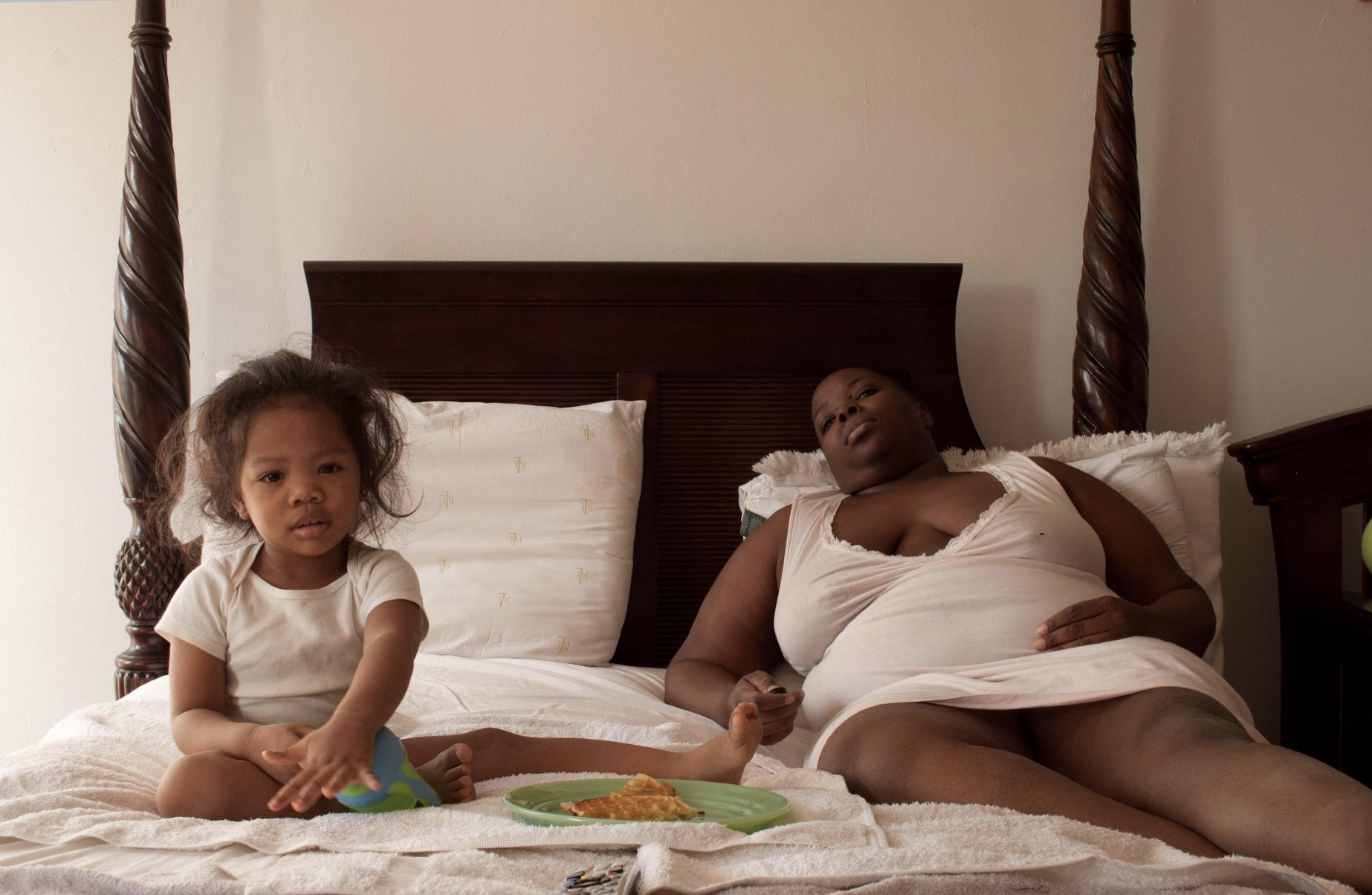
Nona Faustine, Just Another Day in Motherhood, 2010. © 2025 The Estate of Nona Faustine, courtesy The Estate of Nona Faustine and Higher Pictures.
Posing in front of the camera in White Shoes, Faustine needed someone to push the button to take the image. Faustine’s sister, Channon Anita, did the job. Channon Anita is one of numerous unfailingly supportive family members who nurtured and supported Nona Faustine’s creative interests.
“My father was a documentarian, the family photographer. He had this bag of equipment with all these cameras and junk, and I used to go through it,” Faustine told bombmagazine.org in a 2024 interview. “My uncle and father were the ones who put the camera in my hand and introduced me to photography; it was just natural that I had this affinity for the camera and pictures.”
Another of Faustine’s series, Mitochondria, turns the lens on the artist and the artist’s family, documenting and celebrating the lives of three generations of African American women living under one roof: Faustine’s mother, Faustine and her sister, and Faustine’s daughter, Queen Ming. The little girl seen in many of the pictures is now a senior in high school.
“The lives of Black women get very little exposure. The true lives of Black women in the United States, if not in the world, are not seen,” Faustine additional told Bomb magazine. “I wanted to show our lives and who we are. We are very special. Not just because of our suffering, but because of our beauty and strength.”
Mitochondria honors Faustin’s mother, daughter, and sister, and Black womanhood generally as a source of history, knowledge, and resilience.
Rome

Nona Faustine “Ye Are My Witness,” Brooklyn, New York, 2018. © 2025 The Estate of Nona Faustine, courtesy The Estate of Nona Faustine and Higher Pictures.
Faustine’s career was taking off in her 40s. She returned to college as a mother in her 40s to earn a Master’s degree from the International Center of Photography at Bard College. She had the Brooklyn Museum show, an honor especially notable because Faustine worked for many years in the museum’s education department.
Prints from White Shoes went into the permanent collections of prestigious museums across the country including MoMA. And in 2025, a Rome Prize Fellowship from the American Academy in Rome.
Faustine loved Italy. In her final year, she spent three months in Rome as part of the fellowship. Queen joined her.
Channon Anita, Nona Faustine’s constant confidant and co-worker, and helper, now runs her sister’s archive. Chao says Anita is thinking about how to help realize her sister’s final project, ideas formulated in Rome.
“(Nona Faustine) went and did make some photographs in Rome and then had a notebook that has notes on other photographs she wanted to make,” Chao explained.
Hopefully we’ll see them one day. Nona Faustine has always been able to rely on her family.

About Chadd Scott
A midlife career crisis at 40 led Chadd Scott to begin writing about art with no background in it following a 20 year career in the sports media. Learning "Art History 101" from YouTube videos, used books, and podcasts, Scott found the more he looked, the more he liked. He now freelances for Forbes.com, Western Art Collector magazine, Native American Art magazine, and Fodors.com among other publications while operating his own website, www.seegreatart.art, a daily look at art exhibitions and events across the United States. Scott's particular interests in the art world are Native American, African American, and female artists and how art intersects with social justice. As he likes to say, "a people's history is best learned through their artwork." Scott especially enjoys traveling to off-the-beaten-path arts destinations across America. His favorite artist is Earl Biss. His favorite arts destination is Santa Fe, NM. Scott lives in Fernandina Beach, FL.