
Is Creativity Copyrightable? Why Creative Health Is the Question of Our Time
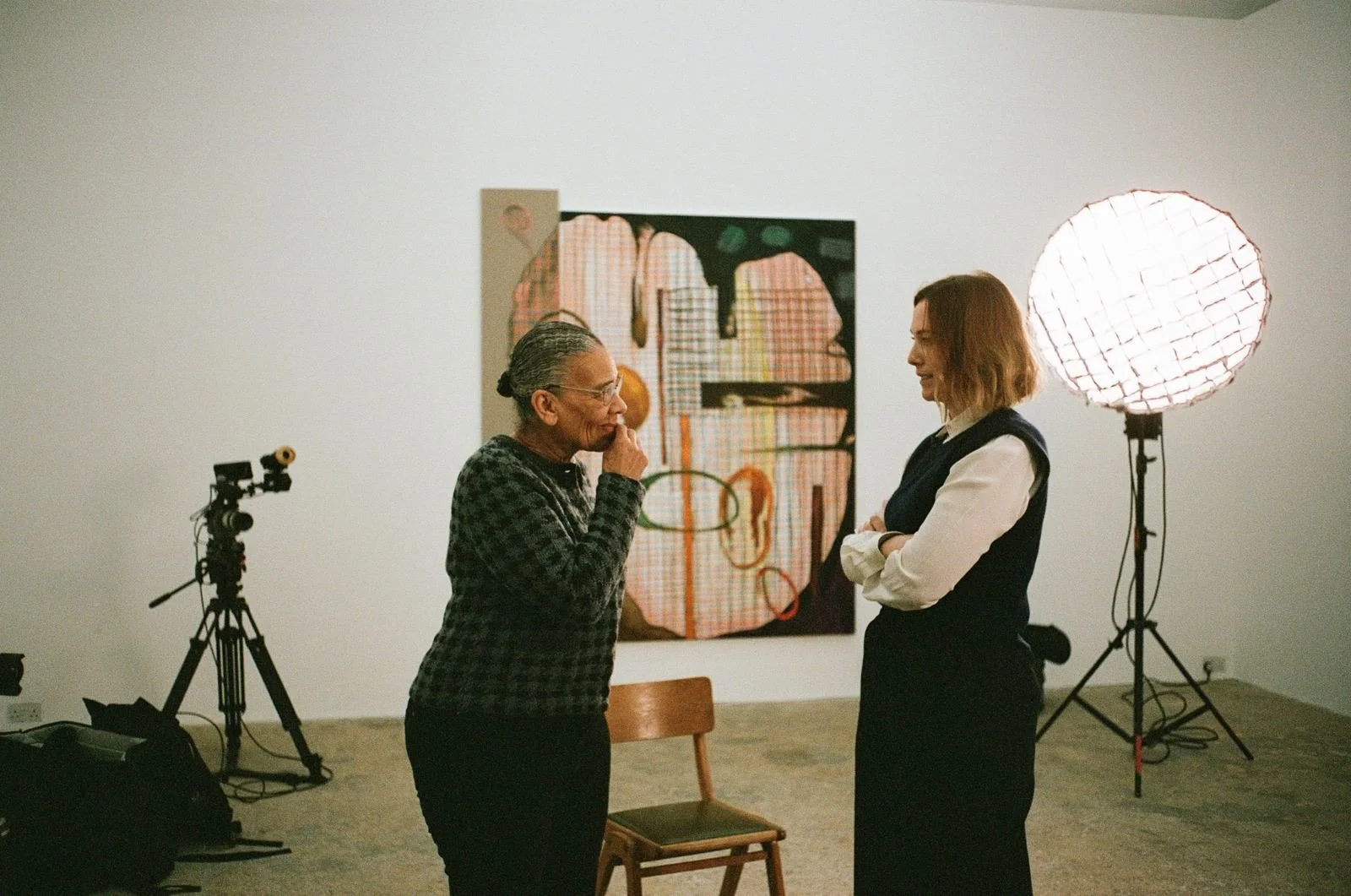
Image: Lubaina Himid and Carrie Scott at Hollybush Gardens, Credit: Andy Dunn.
By Carrie Scott
We talk about mental health constantly. We talk about physical health constantly. Therapy, sleep hygiene, movement, nutrition - these have become the vocabulary of modern wellbeing. But there is a third pillar that almost never gets named: creative health.
Not creativity as talent. Not creativity as luxury. Creativity as a condition of being human - as essential to flourishing as rest or connection.
And right now, that pillar is under extraordinary pressure.
Creativity is simultaneously one of the most valuable resources in the global economy and one of the most vulnerable. As AI learns from our painters and poets, our songwriters and sculptors, the question of who owns creative expression, and who profits from it, has never been more urgent. Which brings me to a question that sounds esoteric but is actually deeply intimate:
Is creativity copyrightable?
What Is Creativity, Really?
I've spent more than twenty years in the art world, and sixteen of those running a business supporting artists outside the traditional gallery model - through documentaries, exhibitions, brand partnerships, and book deals. In 2024, I launched Seen because I wanted artists back at the center of our conversations about art. Not the gatekeepers. Not just the price tag.
Over those years, I've come to think that creativity is not "making something from nothing." Creativity is more like compost.
It requires you to work with what already exists - memory, images, references, language, history, rules, other artists - and then transform it. Artists have always been honest about this. They steal, borrow, quote, collage, study, imitate, metabolize. That's how culture moves. And that's not limited to art-making: great footballers can be creative in the way they play the game, mathematicians in their equations, lawyers in how they apply the law. Success, real success, almost always comes from creativity.
The Legal Scaffolding: How do we protect our creativity?
Fair Use is a start. Copyright law has to draw lines. If everything is free, the original maker can't profit from their work or sustain their creative life. But if nothing is reusable, culture can't evolve. So copyright attempts to balance two truths:
People deserve protection for their original expression.
Society needs breathing room to build on existing culture.
The doctrine that lives in that tension is fair use - the legal safety valve that prevents copyright from becoming a total monopoly over culture.
Courts evaluate fair use through four factors:
Purpose and character: Is the new use commentary, critique, education, parody - something meaningfully different? Or the same thing in disguise?
Nature of the original: Was it highly creative? If so, it gets more protection.
Amount taken: How much was used and was it the "heart" of the work?
Market effect: Did the use replace the original, or damage its licensing market?
No single factor is decisive, but in practice, two tend to dominate: Why did you use it? And did you hurt the original market? Underneath the legal language, fair use is often asking a deeply human question: Are you adding to culture - or free-riding on someone else's labor?
All of these questions are running around my head in an attempt to start to hone in on our collective creative health.
Appropriation as a Power System
Appropriation art is often discussed as though it's a philosophy - "everything is a remix." But in practice, appropriation is also a power relationship. Because the consequences of "borrowing" are very different depending on who you are.
If you're an emerging photographer and a blue-chip artist takes your work and sells it for a small fortune, the question isn't only aesthetic. It's about surviving.
Richard Prince has built an entire career on taking existing images - advertisements, magazine spreads, Instagram posts - and reframing them. He has also been sued multiple times.
In the Graham v. Prince and McNatt v. Prince cases, two photographers accused Prince of using their images without permission in his "New Portraits" series - large-scale prints reproducing Instagram photographs with added captions and comments, sold through Gagosian and Blum & Poe galleries. Prince's defense was essentially: "I transformed the context. I made it about social media."
Courts ultimately weren't convinced. Following the Supreme Court's landmark Warhol decision, both cases resolved with Prince paying $200,000 to one photographer, $450,000 to another, and an injunction limiting future use of those images. And here's the thing: whatever you think of Prince artistically, the question that keeps surfacing is a moral one. Who carries the cost of the art world's celebration of appropriation? Who gets protected, and who gets extracted?
Jeff Koons presents a different but related case. In Rogers v. Koons, Koons closely copied a photograph called "Puppies," directing his artisans to recreate it as a sculpture. He argued it was parody - a satirical critique of mass production and material culture. But the court drew a sharp line: parody requires that the original work itself be the object of the joke, not society at large. Koons was critiquing commodity culture, not Rogers' photograph. That distinction, plus evidence that Koons had acted in bad faith and hadn't sought a license, sank his fair use defense.
The Case That Changed Everything: Warhol v. Goldsmith
Then we arrive at the case that truly rewrote the rules: Andy Warhol Foundation for Visual Arts, Inc. v. Goldsmith.
In 1981, photographer Lynn Goldsmith photographed the musician Prince. In 1984, Vanity Fair licensed one of her photographs as an artist reference, and Andy Warhol created an illustration from it for a single published use. What Goldsmith didn't know was that Warhol had also made an entire series - thirteen silkscreen prints and two pencil drawings - from that same reference photograph.
Years later, after Prince died in 2016, Condé Nast licensed one of those silkscreens - "Orange Prince" - from the Warhol Foundation for a commemorative magazine cover. Goldsmith said: that's my photo being used in the same marketplace. That's infringement.
The Supreme Court sided with Goldsmith, 7–2.
The key move was this: the Court emphasized commercial purpose in the marketplace, not aesthetic difference in the studio. Both Goldsmith's original photograph and the Warhol Foundation's licensed image were being used by magazines to depict Prince. They occupied the same commercial space. Therefore, the use wasn't sufficiently distinct to qualify as transformative.
This isn't the Court saying Warhol isn't art. It's the Court saying: if your use substitutes for the original in the licensing market, you need a compelling justification.
The ripple effects across art, publishing, and brand partnerships have been significant. So has the broader implication: "creative freedom" in practice has too often meant freedom for the more powerful actor to take from the less powerful one. The law, ideally, is supposed to be the place where power gets checked — not amplified.
AI: When Borrowing Becomes Industrial
AI doesn't just borrow. It scales borrowing to an industrial level.
And it forces an old question into a new shape: If creativity is a human health resource, what happens when creativity becomes a dataset?
The U.S. Copyright Office has been clear: copyright protects human creative expression. Purely AI-generated outputs - without meaningful human control over expressive choices - generally don't qualify for the same protection. Prompts alone, the Copyright Office has said, usually aren't enough, because the relationship between a prompt and an output is too unpredictable. You didn't "fix" the expression the way an author does. You initiated a process.
The practical implications are significant. If AI outputs can't easily be owned, companies with scale may benefit most - they can generate endlessly. Meanwhile, the training data used to build those systems was often artists' work, taken without permission. The extraction can happen twice: first, your work becomes training data. Then the market gets flooded with outputs that compete directly with your ability to earn.
That's not just a copyright question. That's an ecosystem collapse question.
What Creative Health Actually Means
So what do I mean by creative health?
I think creativity is a muscle - one we must exercise regularly to retain. Creative health is the ability to make, interpret, and remake meaning over time. It's the missing dimension in how we talk about wellbeing: the third leg of the tripod alongside mental and physical health.
This is deeply personal for me. Art has saved me, repeatedly. After 9/11, as I've navigated my own split culture and identity. As I've healed from the losses life brings. Looking at art - thinking about art - has given me perspective, empathy, and access to experiences I couldn't have reached otherwise.
When I talk to artists about what they need to sustain their creative lives, they rarely say "I need more inspiration." They say:
"I need time."
"I need stability."
"I need to stop explaining my value."
"I need to not be copied without recourse."
"I need to not sign away my rights because I'm desperate."
We are in a moment where a company can say "creativity is everything" while structuring contracts and platforms that quietly make creative people replaceable. Creativity is being treated as a raw material - extractable, scalable, monetizable. And that is a profound threat to the very thing that makes culture possible.
So: Is Creativity Copyrightable?
Creativity itself - the human capacity to imagine and make - no, I don’t think it is copyrightable. And honestly, I'm not sure we'd want it to be.
But the expressions of creativity - the specific works, the images, the photographs, the silkscreens - yes. And the health of the creative ecosystem depends entirely on how well that protection works in practice, across differences in power.
Because creative health isn't just about whether culture gets made. It's about whether the people who make it can keep living.
If the legal system is one of the conditions that shapes creative ecosystems, then the real question is:
How can the law sustain imagination rather than exhaust it?
How do we build a culture where creativity is treated not as a luxury good or a mineable resource — but as something closer to a public good?
And maybe the final question is this: What would it look like to design an art world - and a legal framework - where artists are not the last people paid, the last people credited, and the first people copied?
Seen is dedicated to creative health - reframing creativity not as a luxury or talent, but as a necessary dimension of personal wellbeing. Join today.