
From Fashion Designer to Ceramic Artist: Ben Mazey's Pandemic Pivot That Changed Everything
When the pandemic hit in 2020, most of us were stuck at home wondering what to do with ourselves. Ben Mazey decided to pretend he was on a self-directed artist residency—and accidentally launched an entirely new career.
The Australian artist, best known for his sculptural ceramic practice, spent seven years as design director at Kenzo in Paris before making what he calls a decision to become "holistically ambitious." But it wasn't until COVID-19 forced him back to Australia from Shanghai that his artistic practice truly began.
The At-Home Clay Kit That Started It All
"On day three of lockdown, I was just sitting in this empty apartment—all my furniture and my dog was still in China," Mazey recalls. "I had this real moment where I was like, okay, you've been banging on about wanting to have a sabbatical. This voice in my head was like, you're just going to pretend you're on a self-directed residency and you're just going to start making stuff."
That childhood fantasy of spending summers at a beach house with nothing but bolts of fabric and sewing machines? Mazey was finally living it, only with clay instead of textiles. He ordered an at-home clay kit from a local art store—one of those pandemic pivots where businesses would drop off supplies and pick them up later for firing. He thought maybe he'd try making a lamp.
Six years later, he's working full-time in what he affectionately describes as "some big dumb art bro loft fantasy slash Montessori kindergarten for adults"—a house-studio split in Arncliffe, Sydney, complete with two kilns and his dog.
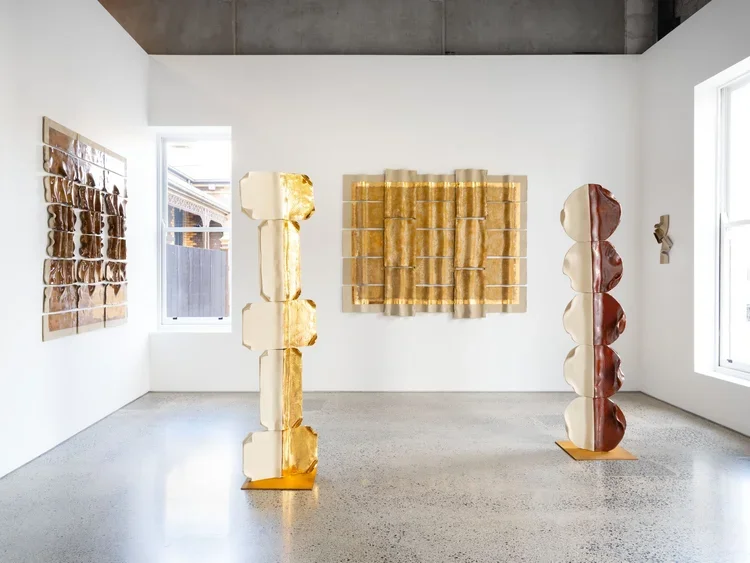
Ben Mazey, in situ, C. Gallery, Courtesy of the artist.
The Beauty of Self-Imposed Rules
Mazey's work centers on a deceptively simple concept: rectangles of clay, 20 by 50 centimeters, manipulated in five different ways. These become the building blocks for everything—what he calls his "flag series," though they're not flags in any traditional sense.
"I vividly remember as a kid, I loved maths because there were rules and it was just right or wrong," he explains. "I find it so great to have those rules for myself. If you had said, just go for it, I wouldn't know where to start."
But here's where it gets interesting: Mazey is constantly breaking his own rules. A grid where one piece does its own thing. A vase that hangs on a wall. These subtle big gestures—familiar yet strange, accessible yet sophisticated—are his signature.
Words That Kick You in the Guts
Among his most compelling work are his text pieces: ceramic plaques featuring twisted aphorisms that make you do a double-take. "May the burns I bridge white the lay." "Get rich or try dying." "How will you know when you're dead?"
They're hard to read because your brain wants to fix them, to say them the "right" way. But that's precisely the point.
"I think like double entendre or something like that—I think the simplicity in those kind of statements that kick you in the guts," Mazey says. "There's something about the accessibility of the word poems that I really adore."
One of his first pieces simply read: "Some people have died, but you haven't." Another asks: "How will you know when you're dead?"
These aren't trivial statements. They're death and mortality wrapped in humor, accessibility masking profound questions about existence.
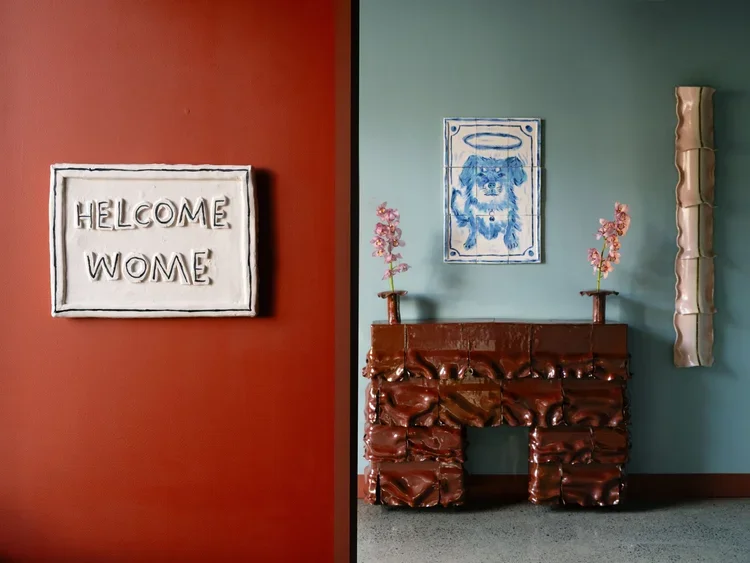
Ben Mazey, in situ, C. Gallery, Courtesy of the artist.
The Death Doula Approach to Art
Mazey's preoccupation with death isn't morbid—it's liberating. When his mother passed away thirteen years ago, he was there, holding her.
"I remember our family doctor literally explaining to me what palliative care meant and he was like, 'You spend your whole life trying to live well and you've now got the opportunity to help your mother die well,'" Mazey recalls. "When mom died, I was like, wow, this just feels like the most miraculous thing that has ever happened and so beautiful, and I still can't wrap my head around the fact that it's going to happen to absolutely every one of us."
His dream commission? A tomb. "I find myself gravitating towards themes of death so much because that's a way that I can constantly remind myself that life's a gift and it just motivates me to make the most of it while I've got it."
Nice Guys Can Make Great Art
There's a lightness to Mazey's work that belies its depth. He uses gold and delft blue, pompous decorative archetypes rendered in what he calls a "Flintstones" way. One show featured a fireplace facade with a portrait of his dog rendered in delft tiles above it. "It is pretty dumb," he admits, "but I don't say dumb in a negative way."
For years, Mazey worried about being "too nice" for the art world. Then he had an epiphany: "I did this full 180 and I just was like, I'm gonna lean into this part of my character that feels very authentically me that is very nice and very enthusiastic and very earnest, and I'm going to not cringe about that side of myself."
He describes his aesthetic as a "cartoon domestic environment"—think beach house signs that say "a bad day fishing is better than a good day at work," but elevated. It's Mary Poppins meets Martin Margiela, humor as the spoonful of sugar that helps profound ideas go down.
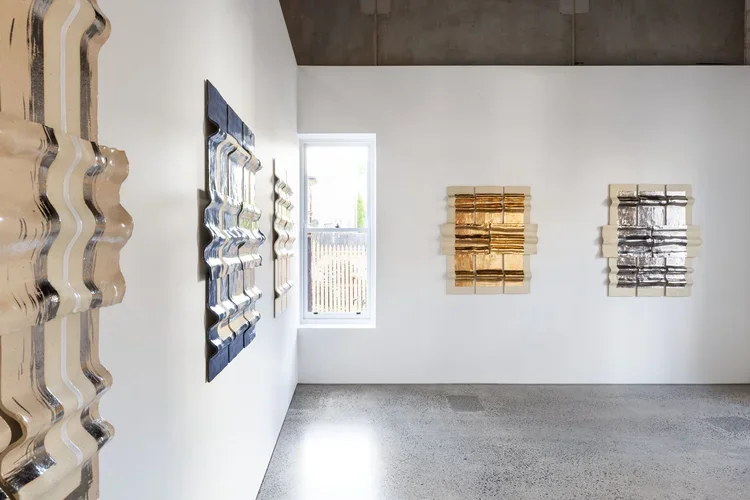
Ben Mazey, install, C. Gallery. Courtesy of the artist.
The Goal: Just Keep Making
When asked what he dreams for his work, Mazey's answer is refreshingly uncomplicated: "Just that people like living with it. And that I just get to keep making it."
He pauses, then adds: "My practice is the first time ever that I just want to keep doing it. I don't want to finish this project. I don't want to clock the game. I just want to keep going."
Any answer beyond that, he suggests, would be coming from ego rather than truth. For someone so comfortable discussing mortality, Mazey seems to have found the secret: not in solving the riddle of existence, but in the daily practice of making things that matter, wrapped in humor, touched with gold, and always, always a little bit wrong.
Ben Mazey's work can be found on Instagram @benmazey. He recently got a gold tooth, which he considers "personal brand building." People are gonna remember that guy with the gold tooth.