
Seeing Up Close at Hamiltons Gallery
Or, remembering why Hamiltons sets the gold standard for the photography market.
By Carrie Scott
I had drinks with friends the other night and was waxing poetic about a rather magical afternoon I’d had at Hamilton’s Gallery. The show they have on right now is something else and I was rather excitedly telling them all about it. My friend looked over her champagne quizzically and asked “isn’t that place run by the guy who dates gorgeous women and looks ridiculously handsome getting off super yachts.” I giggled. There is a certain set of the British population who only know Tim Jefferies as the rather charming playboy who dates all the supermodels.
Little do they know that he is also, in fact, one of the most knowledgeable photography experts on the globe, and his gallery, Hamiltons, will celebrate 50 years in the business next year and is a literal treasure trove for the medium. Jefferies, in fact, sets the standard for the photography market in London and beyond, having been at Hamiltons since 1983. So, if you’d like to start collecting photographs there is maybe no better place to start. And before those of you already in the know tell me that he only shows impossibly expensive Masters, let me stop you right there. That’s just not the case. The gallery has breath and range. And their most recent show proves this point for me.
Hamiltons Gallery is London’s leading photography gallery specialising in the sale of photographs from the mid-twentieth century onward. In the heart of Mayfair, in a space that feels partially like a Bond Villain liar, a nightclub, and a super sexy bachelor pad, the gallery represents some of history’s most important photographers like Helmut Newton, Irving Penn, Herb Ritts, Richard Avedon, and Daidō Moriyama. He also shows contemporary practitioners like Erwin Olaf and Philippe Garner (more on them shortly).
And this show, Up Close, timed to launch alongside Photo London, sails the winning flag for photography as a collectable medium. There is just so much great stuff in it. But what makes it definitively stand out, is that so much in the show is a discovery. Up Close has works by the most well known names in photography but that even the most well versed in the medium might have never seen.
The official gallery blurb reads: “An exploration of intimacy and detail, Up Close surveys the world as seen close up by Modern Masters of photography.” But I think it’s so much more than that. This exhibition is a showcase of Tim’s almost forensic ability to peel back the layers of this market and get access to the best of the best.
Here are my highlights.
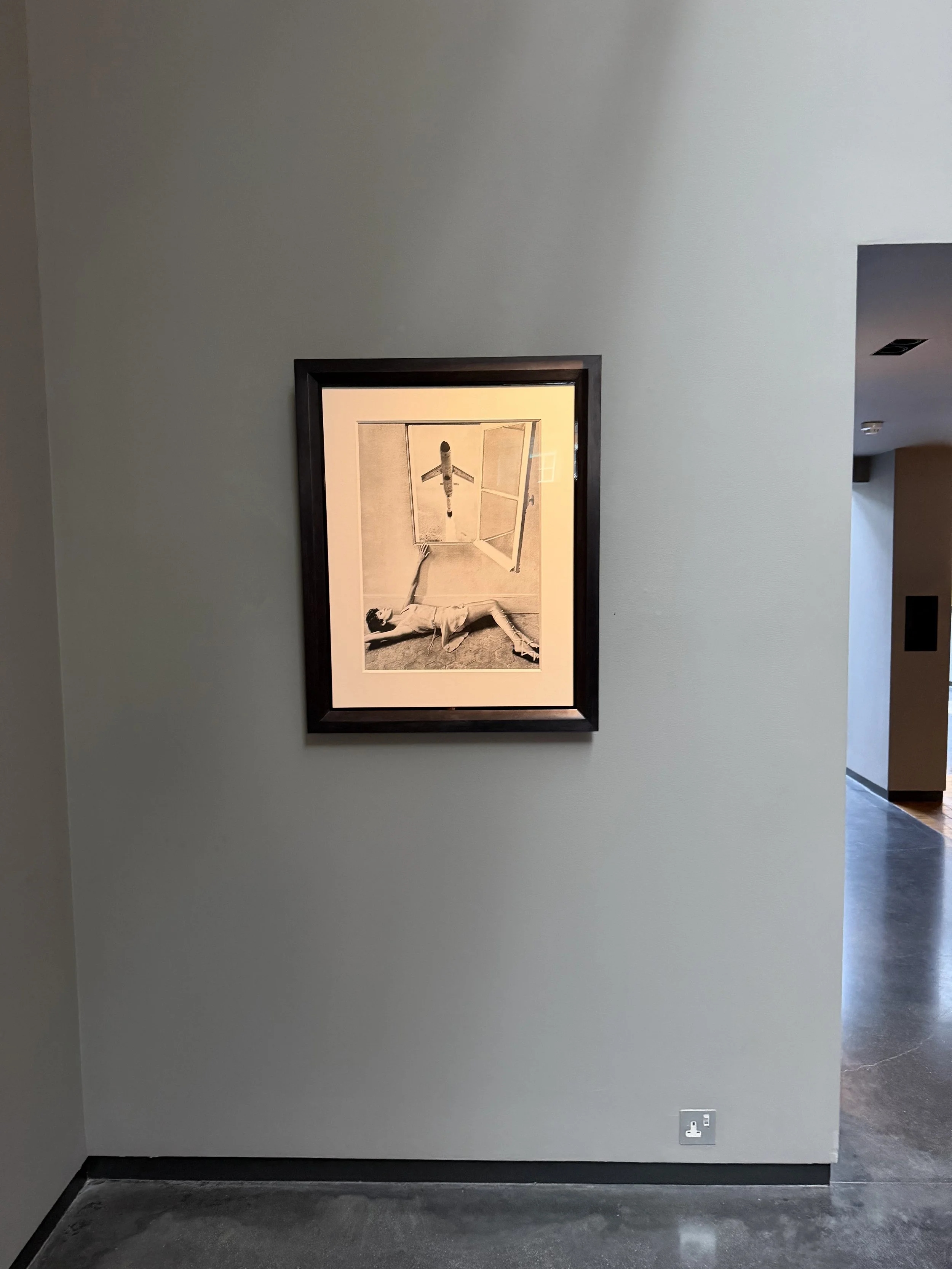
Helmut Newton
Woman watching rocket blast off through open window, Paris, 1968
Gelatin silver print
Unique Print
I was immediately drawn to this photograph the second I walked into the gallery but at first, I couldn’t work out what I was looking at. This surreal portrait depicts a woman lying rather dramatically on the floor, her fingers resting on the edge of a window frame through which we see a rocket blasting through the sky. For those that know Newton, it’s a completely standout composition not at all like his more well-known nudes that feel a little dated these days (I’ve certainly seen enough of them to last a lifetime). Add to that the story through which the image has come into being, and this object becomes an inimitable stand-out in the show.
Newton worked for Queen Magazine during the ‘60’s. The image comes from a story titled “The First Eleven” which ran in the March 1967 issue. As was typical those days, Newton sent the original negatives from the shoot to the magazine so they could reproduce the pictures. But the negs were not returned and were subsequently lost when Queen merged with Harpers in the ‘70’s. But Newton loved this image (for good reason), and decided he wanted to see it as a print. The only way he could then reproduce it was to photograph the page of the magazine and print from that negative. In the industry this is called a “copy print” and explains the somewhat somewhat grainy quality of the print. The image is titled and signed by Newton, therefore, fully endorsed and crucially, it is the only known print of the image, hence being just so unique.
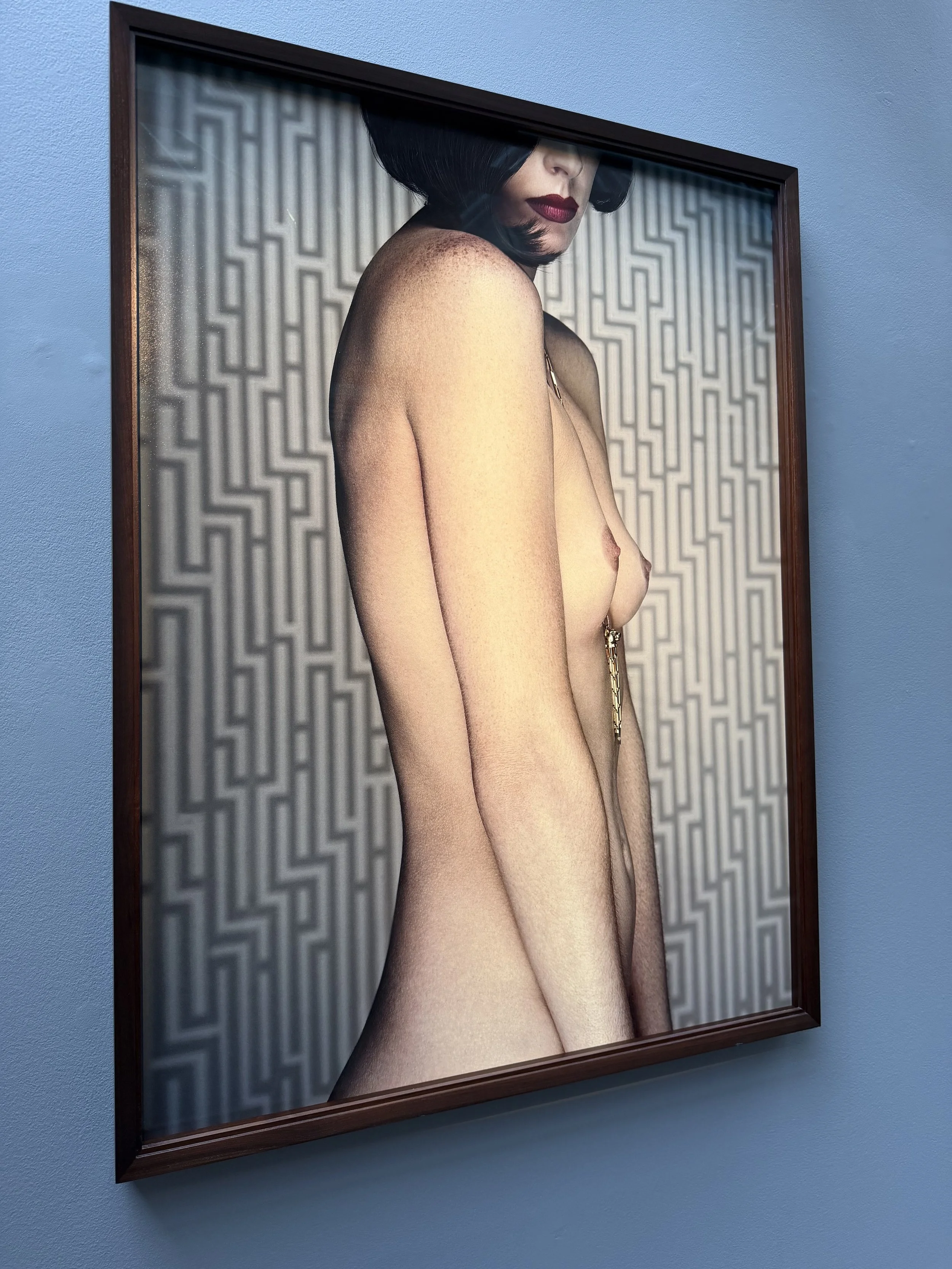
Erwin Olaf
Keyhole 2A, 2012
Archival Print on Canson Platine FibreRag
From an edition of 7 + 2 AP
Keyhole is one of Olaf’s most important series. In it, none of the characters photographed engage in eye contact with the viewer. They look almost past us, the viewer, and in doing so, Olaf places the viewer in the uncomfortable position of voyeur rather than participant.
The psychological distance in these photographs is where Olaf’s skill emerges. He had an extraordinary ability to photograph the details we so often coverup in the manufacturing of beauty in fashion photography. In Olaf’s series we notice goosebumps on skin, tension in shoulders, and the isolation that can exist inside beauty. His images are immaculate, but never empty. Beneath the perfection is vulnerability.
This particular composition is also new to the market. Olaf decided that this version of the work would only be released posthumously. During his lifetime, he refined the image and produced a printer’s proof, effectively preparing it for a future release after his death. We do not know exactly why he made that decision, but somehow the delay deepens the emotional charge of the work. It adds another layer of absence, restraint, and control.
And perhaps that is why the image feels so charged. Her poise, the slight rise of her shoulders, the way her back folds gently forward, the honesty of her skin tone, sits right at the edge: Nothing is overstated, yet everything feels exposed.
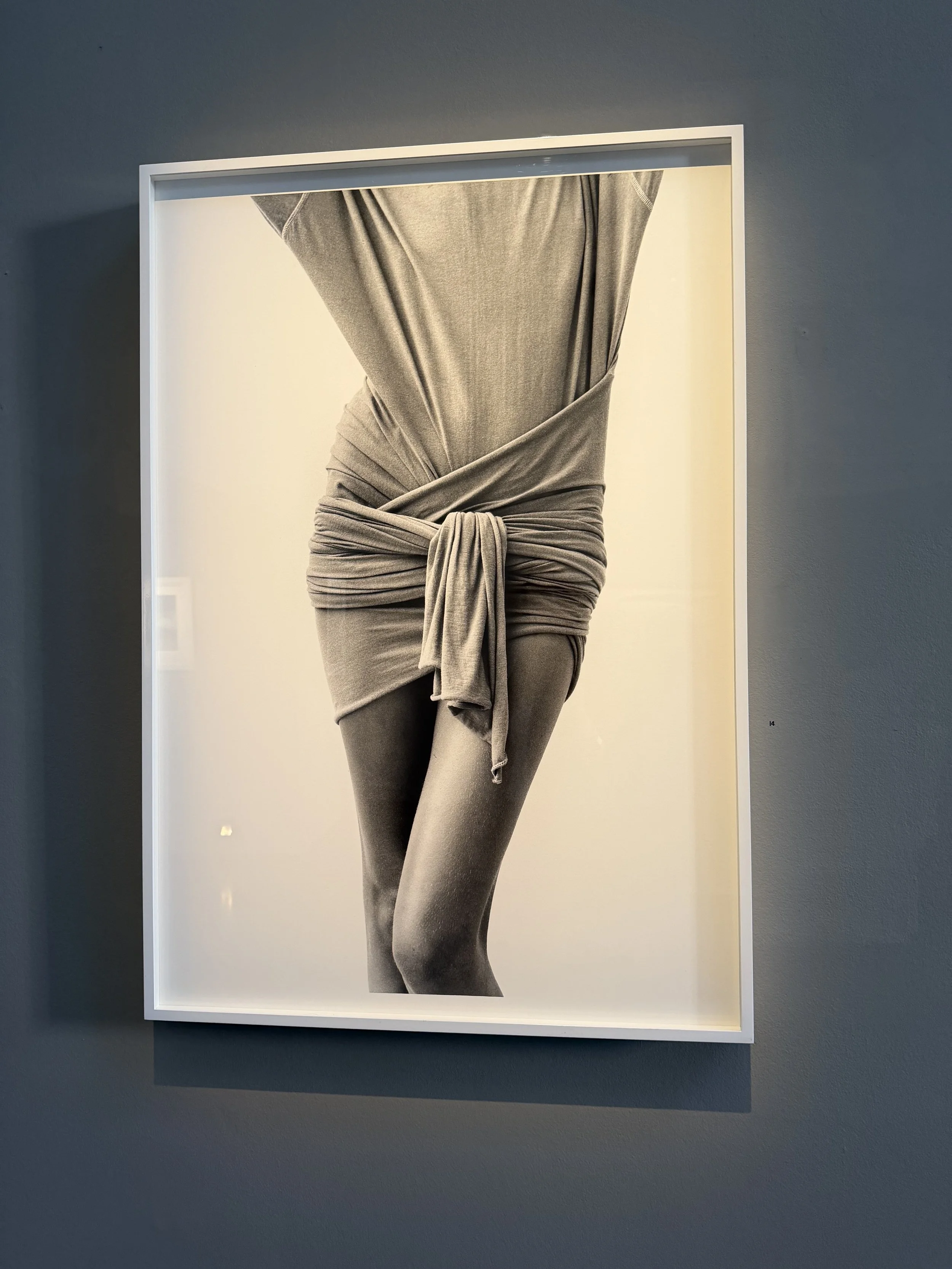
Philippe Garner
Lucilla in my Daylight Studio Wearing a Jersey Wrap Dress by Joseph, Carcès,
1984
Gelatin silver print mounted to aluminium
From an edition of 20 + 2 AP
Garner is another huge name in photography but not because he is a photographer. He is one of the foremost experts in the field. This is not hyperbole. Garner was instrumental in establishing photography as a serious collectible category in the art market, pioneering the UK’s first specialist photography auction in 1971 and going on to lead the photography departments at Sotheby’s, Phillips, and Christie’s over a four-decade career.
While busy establishing himself as an authority, Garner was photographing in secret and perfecting his craft by carefully studying the Masters with the patience of someone who truly understood the medium. And after all those years of looking, he developed an extraordinary sensitivity to form, balance, and intimacy. This image feels like the culmination of that understanding. The subject is his wife, Lucilla, and you can feel the deep trust between them. I love the way she holds herself, arms stretched above her head, completely at ease, and the way Garner photographs her with tenderness, desire, and deep respect.
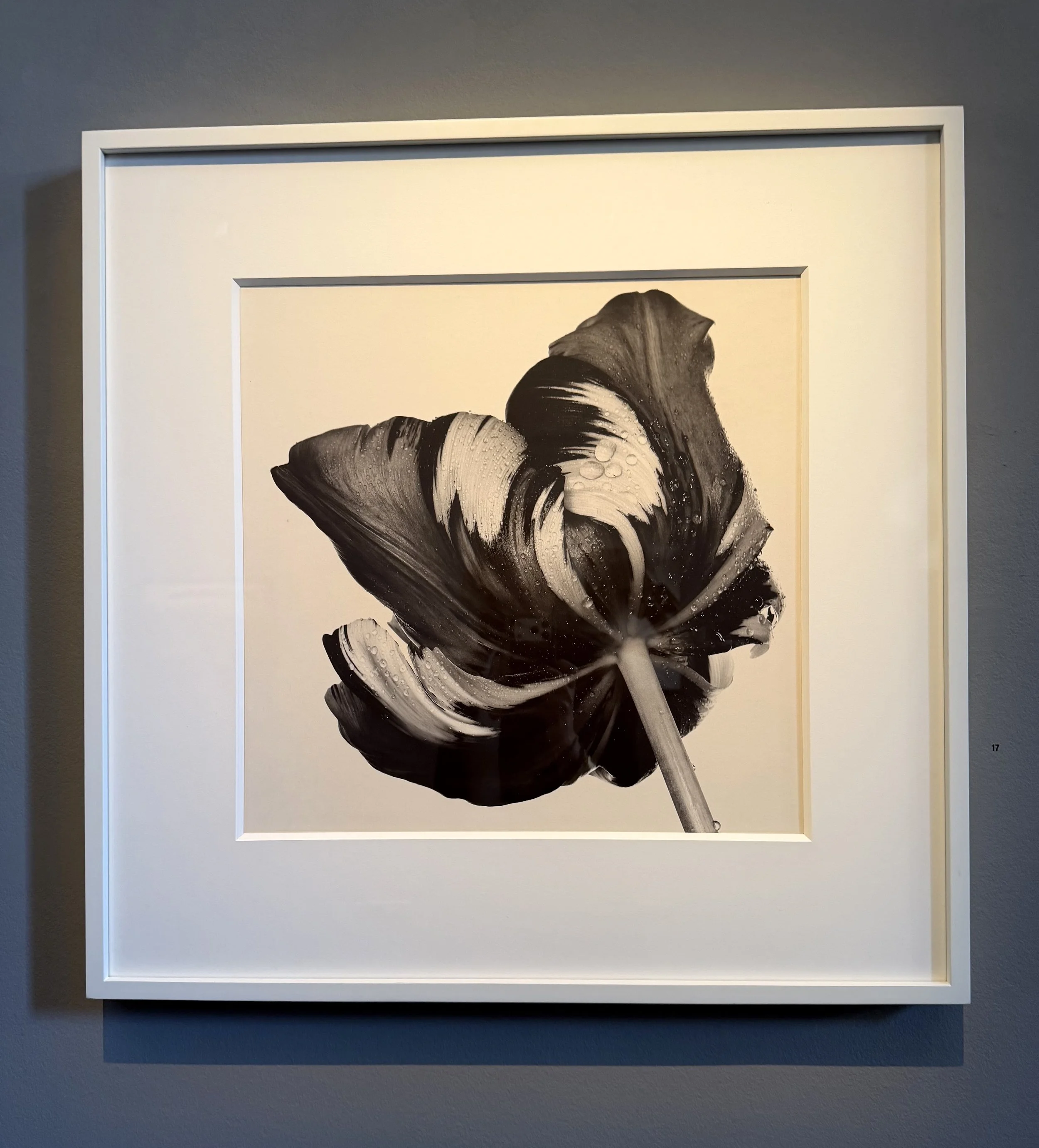
Irving Penn
Cottage Tulip: Sorbet, NYC, 1967
Platinum palladium print mounted to aluminium
From an edition of 9
Irving Penn is perhaps the greatest photographer ever, of all time. Revered both for his unparalleled compositions and remarkable printing techniques, the man helped dissolve the boundary between commercial photography and fine-art photography. Nowhere is this more evident than in his flower photographs. Seductive, melancholic and almost confrontational in their beauty, they transform the still life into something emotionally charged.
This tulip comes from one of Penn’s most celebrated series, in which blooming and decaying flowers became meditations on fragility, sensuality, and time itself. Most people know this image in colour, with complex purple tones that feel vivid enough to taste. But at Hamiltons we are seeing something far rarer: one of only two flower images Penn ever produced as platinum palladium prints, a process that produces an almost velvety depth and tonal subtlety that suits this composition perfectly.
Photographed in his New York studio, the tulip becomes monumental in Penn’s hands. The curve of the stem. The bruised richness of the petals. The way the flower seems to hover somewhere between elegance and collapse. Penn understood that beauty becomes more powerful when touched by imperfection.
Up Close is on until 30th June, 2026 at Hamiltons Gallery in London.
13 Carlos Place
London
W1K 2EU
Opening hours: Monday - Friday, 10am - 6pm. Saturday 11am - 4pm.