
What does “American Art” even mean anymore?
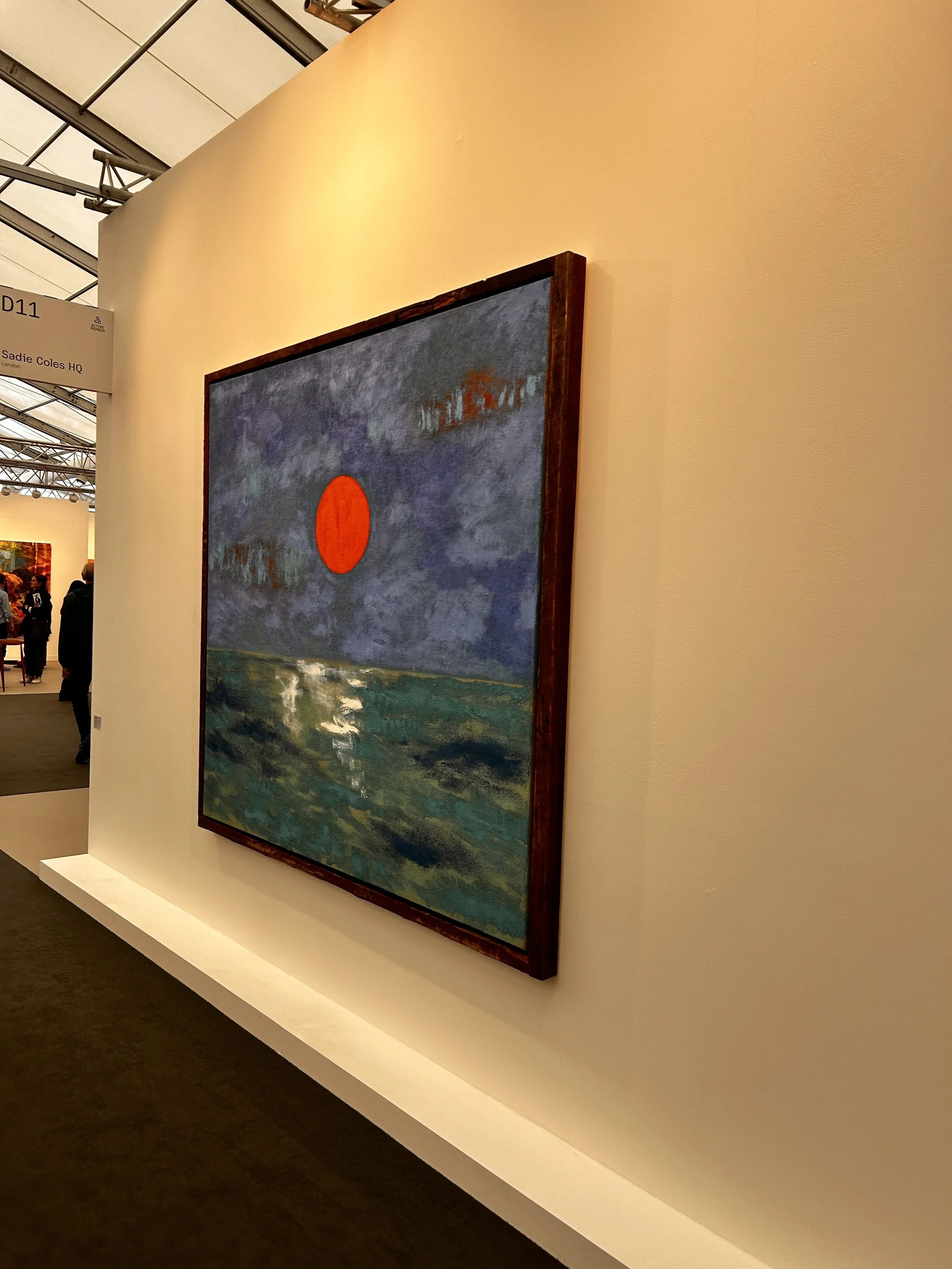
Alvaro Barrington, Big Ocean, Caribbean Blues, L, August 2024, on view at Frieze London 2024 with Sadie Coles HQ
A panel discussion that really got me thinking about what “American Art” even means anymore?
By Carrie Scott
I was invited by the Royal Academy to join the remarkable artist Alvaro Barrington, curator and all around cultural thinker Zoé Whitley and the incredibly astute journalist Rebecca Jones to discuss American art as part of the Lunder Institute for American Art at Colby Collect initiative to invite institutions to look critically at what is American art, its history, its future, and its evolution.
And our discussion fundamentally got me thinking about what “American Art” even means anymore. When most people hear the phrase “American art,” I think they still picture a very particular thing of big canvases, gestures and egos. I think I do. We picture Jackson Pollock splashing paint in a barn. Mark Rothko bathing rooms in existential dread. Willem de Kooning wrestling with abstraction. The mythology of postwar New York still dominates the global imagination of what American art is supposed to look like. A heroic, masculine, individual and mostly white pastiche.
And there’s good reason as to why that’s the case. The first image of America that was exported visually came through the Farm Security Administration photographs during the Depression. Photographers like Ansel Adams, Dorothea Lange, Walker Evans, Gordon Parks were commissioned to construct a visual language around hardship, labour, migration, and survival. The FSA created one of the first coherent visual identities of America itself. It mythologised resilience and aestheticised struggle. It built a kind of emotional architecture of “Americanness.”
Then came Abstract Expressionism, and one of the most fascinating stories to both art and non-art people alike because the CIA, yes the CIA, is purported to have helped make Abstract Expressionism famous. After World War II, the United States needed cultural dominance as much as military dominance. The Cold War wasn’t just being fought with weapons. It was also being fought through ideology, aesthetics, and culture. America needed to prove itself as the land of freedom, individuality, and unrestricted thought. And what better symbol than massive, emotionally explosive abstract paintings that appeared to reject all forms of state control? And - more than that - these paintings were abstract so you could ascribe meaning to them with ease in a way a realist painting just wouldn’t allow.
The irony is wild here of course, because many of these artists were deeply alienated from American society. Pollock was a rebel. Barnett Newman identified with anarchist ideas. Rothko distrusted capitalism entirely. But their work became useful propaganda anyway. The CIA, often through indirect channels and cultural organisations, helped fund international exhibitions that circulated American abstraction across Europe. The Museum of Modern Art played a critical role. And everyone, collectors, institutions, critics, museums, and government aligned around the idea that America was now the centre of modern art. And the world believed it. By the late 1950s, New York had overtaken Paris as the cultural capital of the art world.
The market followed and, though I am obviously oversimplifying here as well as skipping decades of detail, today the American art market still absolutely dwarfs almost everyone else. The scale of collecting, institutional funding, private philanthropy, museum infrastructure, and auction power remains unmatched. The latest Art Basel and UBS report shows the US still accounts for 43% of the global art market by value, maintaining a level of dominance no other country comes remotely close to. Even as the wider market contracted from $64 billion to $57.5 billion in 2024, America remained the undisputed centre of high-end art sales.
And the mythology around “American Art” still carries enormous financial weight. Just last week, another Pollock sale reminded everyone how powerful this exported version of “American art” still is. Pollock is no longer simply an artist. The drip paintings became symbols of freedom, rebellion, masculinity, and postwar American dominance, and the market continues to price them accordingly.
But here’s the thing: I’m not sure the definition of American art actually holds anymore. Or maybe more accurately, the idea of a national aesthetic itself is collapsing. And nowhere do we see that more clearly than at the Venice Biennale. Two years ago the central exhibition was titled “Foreigners Everywhere”. This year the curatorial framing shifts again toward “In Minor Keys.” Both exhibitions move away from certainty, monumentality, and fixed identity. The emphasis is no longer on dominant national narratives but on fragmentation, softness, hybridity, and overlapping histories.
And this feels like a thing, or a shift. Because the old model of national art movements was built in a world where cultural identity was treated as stable. We had French art, American art, Italian art, British Art. Movements attached to geography and power structures that felt comparatively fixed. But contemporary culture no longer feels fixed, not personally, not globally. Artists live everywhere, work everywhere and even show everywhere. They move between languages, identities, materials, and political contexts constantly. And let’s be honest, the internet flattened geography and globalised taste, and the result is that national identity in art has become far less visually coherent.
And honestly? America itself has changed too. While the dominant image of “American art” still tends to centre white male abstraction, the actual story of American culture has always been far more unstable and plural than that narrative allowed and I think you can feel the canon straining under the pressure of correction. Take Janet Sobel, for example, who is finally being recognised. Sobel was a self-taught immigrant woman from The Ukraine working from her kitchen table in Brighton Beach, experimenting with poured and dripped paint years before Pollock became synonymous with the technique. Clement Greenberg and Pollock both admitted they had seen her work and been affected by it, yet history largely reduced her to a footnote in Pollack’s story, which feels symbolic of the larger problem.
We have to remember that the canon of “American art” was never neutral (they never are!). It was built by those aforementioned institutions, critics, markets, museums, politics, and a bunch of money. Certain artists were elevated into symbols of national identity while others were sidelined because they complicated the narrative. And now the narrative itself feels unstable. And that’s ok. More than that, I think it’s cause for celebration.
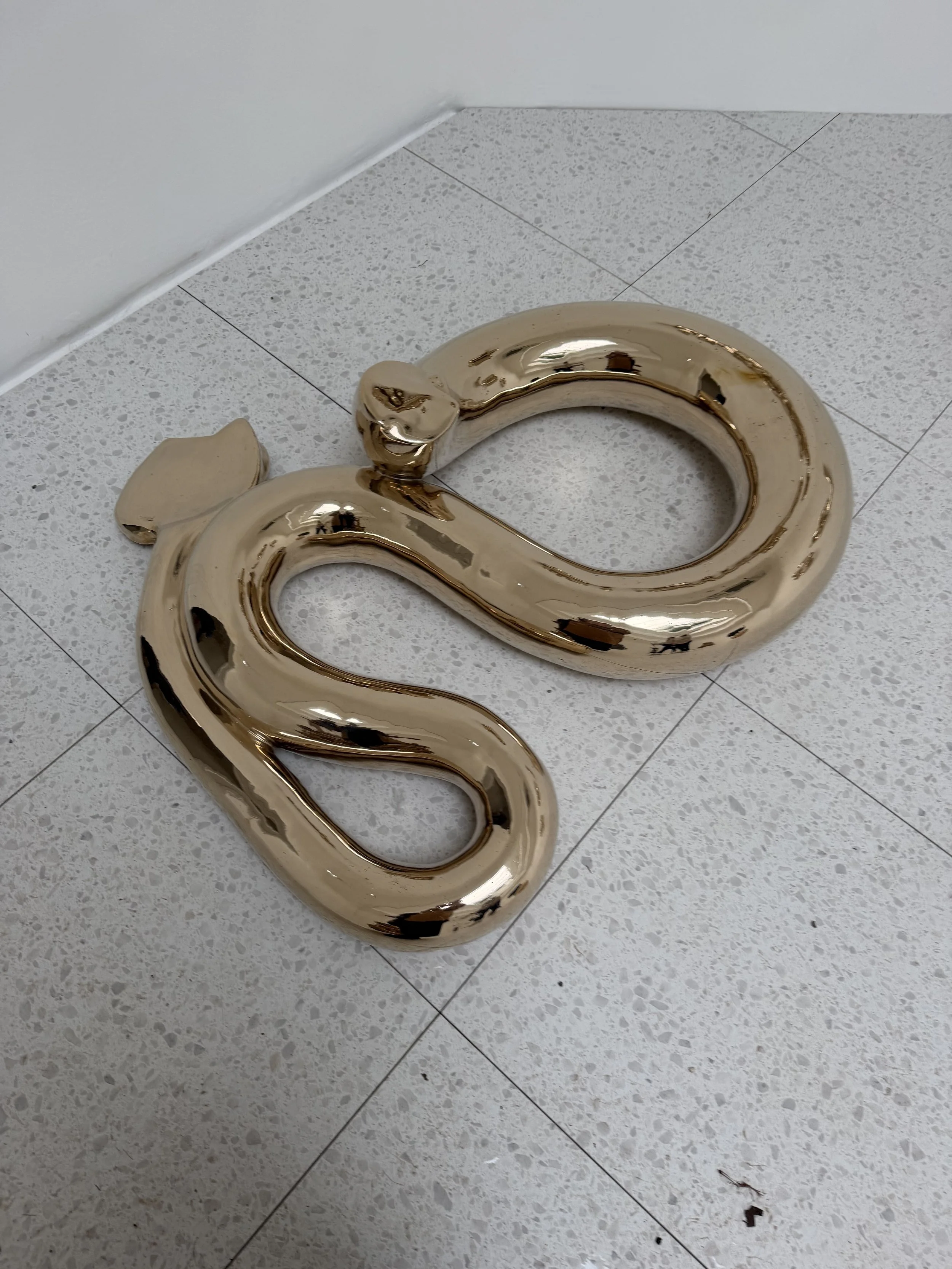
Alma Allen, Not Yet Titled, at The US Pavillion, Venice Biennial 2026
Even the American pavilion at Venice this year seems to reflect that uncertainty. Alma Allen’s biomorphic sculptures don’t exactly project the muscular certainty of postwar American dominance. If anything, they feel unresolved. Ambiguous. Soft around the edges. Every sculpture titled “Not Yet Titled” so that none of them are fixed, or complete. They are somehow still becoming and that honestly might be the most accurate description of America itself right now.
Because I am sure that “American art” was never a stable aesthetic category in the first place, it was always just a projection, an export and market/political construct and a story America told the world about itself until the world accepted it as real.
And now we are entering a moment where those certainties are fracturing though not disappearing entirely. Pollock still sells, while Rothko still soars in museums (and for good reason) and the market still overwhelmingly rewards the mythology of postwar American power. But the cultural conversation is shifting underneath it all because the centre no longer holds in quite the same way. And maybe that’s healthy, because maybe the most interesting thing about American art today is that nobody entirely agrees on what it is anymore.
And in fact, I think that is what American art has actually really been about all along. It has struggled with the impossibility of defining itself because the dominant narrative was always so narrowly white, male, and monumental. Underneath that official version of “American art” was always another America pushing back against it made by the immigrant artists, the black artists, the women artists, the self-taught artists, the artists whose relationship to the country was conflicted, unstable, angry, and unresolved.
Which is why I keep thinking about the quote Zoé Whitley read during the talk at the Royal Academy from Faith Ringgold which said:
“I have watched freedom being restricted every day of my life. I don’t mind struggling. At least, here in America you have the freedom to struggle.”
That line feels incredibly important in the context of American art history. Because maybe American art is not defined by a single aesthetic at all. Maybe its defining characteristic is the struggle over who gets included in the story in the first place. The constant friction between the official mythology of America and the more real lived experience. Which is why the idea of a fixed national art now feels increasingly impossible. Not because American art has lost its identity, but because we are finally seeing how many competing versions of America were always there underneath it.
Which is precisely what Alvaro does in his work time and time again, and what he did on stage too. His practice refuses singular identity. It moves between geographies, histories, materials, and cultural references without asking permission to belong neatly to any one category. The work understands and shows America not as a fixed image, but as a collision of migrations, contradictions, aspirations, and inherited histories all happening at once. And it’s all the better for that.
Liked this article? Support Seen by becoming a paid member.