
Rooms as Portraits: Painter Lottie Cole on Interiors, Identity, and the Stories Spaces Tell
Lottie Cole: My Relation, Elizabeth Bowen is open at Long & Ryle from 3 - 28 June 2026
There's a particular kind of longing that hits when you look at Lottie Cole's paintings. The armchair angled just so, the books stacked with the confidence of someone who actually reads them, the light coming through a window that leads somewhere you can't quite see. I don't just want to look at these rooms. I want to walk into them.
Cole, who is showing new work at Long & Ryle in London from 3rd June, has made a career out of painting interiors that are, in every meaningful sense, portraits. No subjects required.
"If there was a person in that space, they would be occupying it," she said. "And you can't imagine yourself going in there." So she leaves them out. The result is an open door - a standing invitation to step inside lives that feel intimately familiar even though they belong, technically, to no one.
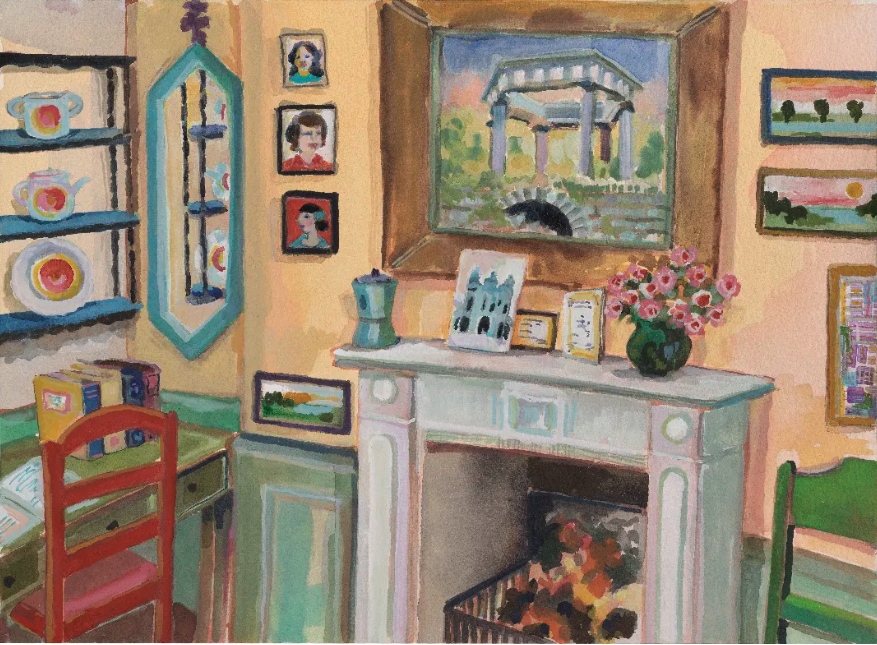
Lottie Cole, Temple, The Neale, Mayo, 2025, Watercolour and gouache, 31 x 41 cm
The Room as a Container of Time
Cole's earlier work drew on real spaces like the Bloomsbury interiors of Virginia Woolf and the painter Vanessa Bell at Charleston Farmhouse and Monk's House in Sussex. What drew her wasn't the literary celebrity of it all, but something more personal: the oil-filled Aga at Monk's House that smelled identical to her grandparents' home. "It was so reminiscent of my grandparents' house," she says. "The smell of it was so identical."
That instinct to find the private echo inside the public monument runs through everything she does. After exhausting the Bloomsbury series (she's refreshingly clear-eyed about when a love affair is over: "when you're over it, you're over it"), she began inventing her own rooms, furnishing them with imagined lives, and crucially, filling the walls with the work of women artists who had been quietly erased from the auction house canon.
"The irony is that they were probably just as successful as the men during the time when they were alive," she says. "But as soon as they die, they just get forgotten." Cole's painted rooms became a kind of rescue operation not as archives, but as living spaces where overlooked work gets hung on walls and admired over dinner.
Elizabeth Bowen and the House That Was Pulled Down
For her new show, Cole found an unlikely muse in the Anglo-Irish novelist Elizabeth Bowen which was a discovery that began, as the best ones do, with an uncanny string of coincidences. They have the same surname, the same Irish heritage, a shared school and a mutual fixation on North London. And then there was how Bowen looked: "She looks so like a lot of my great aunts," Cole says. "Velvet berets on an angle with a brooch. Very smart, but very threadbare."
But it was Bowen's writing about interiors that sealed it. In a BBC interview Cole stumbled upon, Bowen describes houses as "containers of time" - spaces that hold gravity, that create the conditions for memory and meaning. Cole heard herself described back to her.
Bowen's own house, Bowen's Court in County Cork, was eventually sold to a farmer who - in a detail that feels almost too brutal to be real - attached chains to opposite corners and pulled it down. The valuable timber, apparently, was the point. Bowen reportedly said it was better to think of the house not existing than to imagine it existing without her.
"That deep connection to a house and its life," Cole says quietly. "I just thought that was so fascinating."
Cole travelled to Doneraile Court in Ireland to research the show, visiting the graves, leafing through family photograph albums, tracing the ghost of a house through secondary images. One painting shows the steps of Bowen's Court in moonlight, dinner party sounds drifting from inside, summer light pooling at the threshold. Another features a small architectural model of the house - which may not exist in real life, but feels like it should.
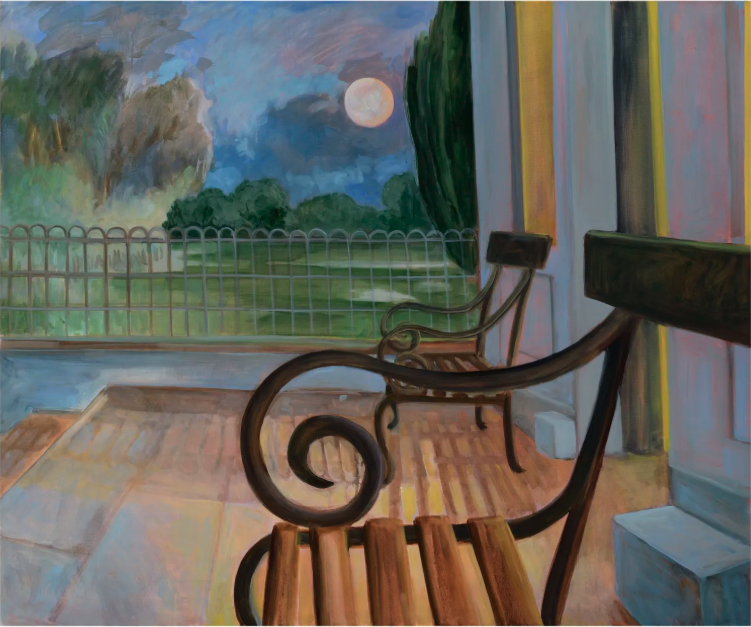
Lottie Cole, Moonlit Front Steps at Bowen's Court, 2026, Oil on canvas, 100 x 120 cm
The Parallel Lives Problem
There's a thread running through Cole's practice that she seems almost bemused to find there: the desire to inhabit other lives without actually having to live them. She admits to loving the idea of moving house constantly, a trait apparently hereditary, inherited from great-aunts who relocated every two years between villages a mile apart, but also to the uncomfortable truth that wherever you go, you take yourself with you.
"I always imagine moving somewhere," she laughs, "but then you think, but I'd be there if I moved there." The paintings solve this neatly. She furnishes the rooms in her head. She buys the art she can't afford. She inhabits the life of a person who is, on inspection, just herself with different books on the shelves.
That quality of a life fully imagined without being fully lived is exactly what makes her interiors feel so charged with presence. These aren't empty rooms. They're rooms waiting to be remembered.
Lottie Cole's new show opens at Long & Ryle, London, on 3rd June and runs through 28th June . The gallery is a three-minute walk from Pimlico station, just behind Tate Britain.
If you'd like to read alongside the show, Cole recommends Elizabeth Bowen's novel The Last September.